Monday, 7 August 2017

After the rain

I'd been cooped up all week with a cold, so I was desperate to get out on Saturday to cop a look at some of these mushrooms that have been popping up everywhere recently. As I was still feeling a bit ill, I thought I'd better not go for a walk in the pouring rain and waited impatiently for the showers to pass. Which they eventually did.

To the woods!

It was late afternoon by the time I arrived at Horton Wood.

I'd walked perhaps 50 metres into the wood when I noticed a splash of colour to my left. Russulas!


Alas my fungus identifications skills don't yet stretch to identifying Russulas (unless they're green and crusty looking).

But this slug seemed happy it had found a tasty meal.


Much like at the nearby Hoe Wood, a crop of Fairy Inkcaps Coprinellus disseminatus were beginning to popping up on one rotting log. (Although it's just occurred to me, I should have checked more closely that these aren't Psathyrella pygmaea, as they're not growing in quite the profusion I've come to associate with Fairy Inkcap C. disseminatus).


A little further into the wood, I came across these beauties.


The cap was spectacularly, well, 'beardy'.


Around the stipe, it had a thick and elegantly constructed ring.


 The gills are free and rather distant from the stipe. And the flesh blushes slightly red when damaged.


I think these features add up to Shaggy Parasol Chlorophyllum rhacodes. A first for me.

This patch of mushrooms was growing very nearby and I assumed they were the same species.


Looking back, their growing habit clustered together like this – and the scaliness of the cap are quite different. I should have taken a closer look!

UPDATE 06/09/2018 - looking at this again, I wondered if this cluster of mushrooms could be a species I've recently become aware of: Agaricus bohusii. Feedback on the BMS Facebook page suggests that this is very likely to be A. bohusii.

This large Agaricus also caught my eye, growing among leaflitter, in a scrubby area of the wood. The cap and stipe had the colour of tobacco stains.


The flesh didn't appear to blush red upon being cut, which I think rules out some of the woodland species. I'm drawing a blank with this one.

On my way back, I was pleased to encounter this pointy fellow.


Flicking through the Collins (photographic) Guide, it struck me as a good match for Split Fibrecap Inocybe rimosa.

Another, more mature, fruitbody growing nearby showed characteristic splitting in the cap.


However, some further research led me to this cautionary note, on the first-nature website:

"Inocybe is a difficult genus, with numerous 'little brown mushrooms (LBMs as they are commonly called) that to the naked eye appear to be identical until they are examined under a microscope... and even then it is very difficult to separate many of them."
There is an article in volume 16(3) of Field Mycology (£) which includes "A key to reddening species of Inocybe in Britain". I looked to see if my mushroom showed any signs of reddening. It didn't.

I think I shall need to get hold of a copy of Keys to British species of Inocybe (Outen & Cullington, 2015) if I want to make any progress with this one. But the microscopy required sounds fairly hardcore...

UPDATE 09/08/2017 - I have been in touch with Penny Cullington who has been most helpful and sent through details of how to access the latest edition of Keys to British species of Inocybe (Outen & Cullington, 2015). She mentioned that mushroom pictured above might be Split Fibrecap I. rimosa and "a look at the gill edge should confirm or deny that for you."

Well, I do like a challenge.

Here's another photograph of the gills, after they've been sitting on a shelf in the spare room for a few days; along with a spore print.


The gills, which look creamy-grey in the first photograph (which was taken in the field) have now turned a rather attractive shade of brown; but they've retained a striking creamy-grey edge to them.

I've tried having a look at the gill edge down the microscope; but I'm really not very good at this! All I can see is this sort of thing:


I can't see anything that looks like 'metuloid cystidia' (thick-walled cystidia usually having crystals at the apex), which would indicate something else entirely.

I note that the key describes the smell of I. rimosa  as being "spermatic". Having googled the definition of 'spermatic', I can confirm it does mean what you think it means. Is that how this mushroom smells? Pass. (I've got a cold.)

Finally, as the light was fading, I came across these sweet little boletes – about the size of a fifty pence piece.


 There was some reddening to the stipe, particularly near the top. And yellow pores.


Here's a better look at those pores (after the mushroom's been in the fridge for a couple of days).


I didn't detect any particular colour-change in the flesh, when damaged.


Unfortunately I haven't succeeded in making this mushroom definitively BE anything. Not having had much experience with boletes, working my way through the keys in British Boletes (Kibby, 2016) is still something of a challenge.

In over 18 months of regular foraying in Horton Wood, I think that's my most impressive haul of mushrooms yet. In August!

For the record
Date: 5 August 2017
Location: Horton Wood, Small Dole
Grid reference: TQ208127 (site centroid)

C. rhacodes and A. bohusii records entered into FRDBI 06/09/2018 

Monday, 31 July 2017

Ambersham delights

I was at Ambersham Common on Sunday for the Heathlands Reunited Bioblitz event, organised by the South Downs National Park Authority.

Ambersham Common is one of the important heathland sites in the South Downs National Park. As well as great expanses of heather, which were putting on an impressive show this weekend, it also includes areas of birch woodland and conifer plantation.

After the recent rain, mushrooms were popping up all over the place – looking fabulous.


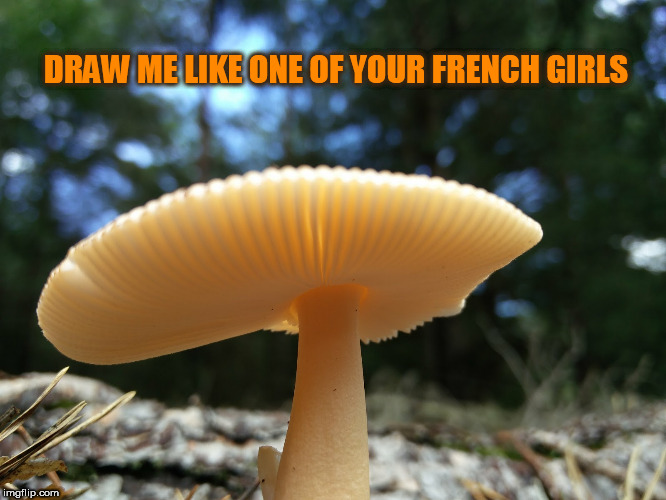
I think this one, with its tan-coloured cap, stripy edge to the cap ('striate margin') and bag-like volva at the base of the stipe, is Tawny Grisette Amanita fulva.


This photo shows cap colour and striate margin quite nicely.


It really is an elegant looking thing...


... quite coquettish. So much so, I think it deserves to enter the canon of "draw me like one of your french girls" memes. Those gills! That stipe!


Apparently (according to wikipedia), the word "grisette" was commonly used in the 19th century to refer to a French working-class woman and in 1835 was defined in one of the French dictionaries as: 

"a young working woman who is coquettish and flirtatious."

So the meme is more apt than I'd realised. Ha!

In an area of birch and conifer woodland nearby I spotted the crusty cap of another Amanita.


Here it is up close.


It had a pendulous and striate ring around the stipe.


I have convinced myself the flesh turned slightly pink when damaged. It also didn't smell of radishes (a feature of the similar-looking Grey-spotted Amanita A. excelsa var. spissa). I think this makes my mushroom The Blusher Amanita rubescens.

That particular mushroom was growing singly but, along one of the rides at the edge of the Common, we also came across this group growing together. I think these were also The Blusher Amanita rubescens.


Down the slope, in another area of conifer woodland, I was delighted to come across this bright pink slime mould, growing on a rotting conifer log.


It was very helpfully showing off both its amorphous pink plasmodial form (shiny blob at the top), and its pink 'pseudoaethalium' – the densely clustered group of spore-producing structures called sporangia.

In this photo you can see the sporangia are shaped like lots of tiny sausages, sitting on top of a layer of white gunk called the hypothallus.


Looking downwards on the fruit body (as in the top photograph) you just see the tips of the sausage-shaped sporangia, looking a bit like a raspberry.

All these features are a good match for Red Raspberry Slime Tubifera ferruginosa. Bruce Ing, in his book The Myxomycetes of Britain and Ireland, notes "there are no other species to confuse with this in the British Isles; it can be identified as soon as it emerges from the wood." So I think I can be reasonably confident in this identification.

Growing on another rotting conifer log, I found these pale yellow blobs. They looked too misshapen to be Small Stagshorn Calocera cornea, which I've seen in a few places recently.


Looks like it might be Pale Stagshorn Calocera pallidospathulata, which the Collins (photographic) Guide says grows on the decayed wood of conifers.

Another interesting find for me was this bracket fungus growing on birch stumps.


When my friend Laurie pointed this out to me, I just caught a glimpse of some fairly flat semi-circular brackets with concentric rings of colour and gave her my stock response for moments such as these: "I think it's Turkeytail."


But something made me take a closer look, and what I found on the underside took me completely by surprise.


Gills! It seems Laurie had found Birch Mazegill Lenzites betulinus. Another new species for me.

For the record
Date: 30/07/2017
Location: Ambersham Common and surrounding woodland
Grid reference: SU9119 

Records entered into FRDBI 06/09/2018 

A lurid bolete


I got some help from the folk on the British Mycological Society Facebook page in order to identify this bolete I found at Woods Mill on Saturday, growing in a scrubby area at the edge of Hoe Wood.

Cap is yellow-y brown; discolouring red where it's been damaged.


Tubes remain whole when split. And there's a distinct red line above the pores: this is significant!


As with many bolete mushrooms, the flesh turns (slightly) blue when cut and the pores turn deep blue when bruised.


The stem is covered in a coarse and elongate network pattern.


I'm grateful to Slavko Pavlović, Antony Burnham and Geoffrey Kibby for explaining that these features particularly the coarse network on the stem and that red line make this mushroom a Lurid Bolete Suillellus luridus.

For the record
Date: 29 July 2017
Location: Woods Mill (edge of Hoe Wood)  
Grid ref: TQ217136 

Record entered into FRDBI 06/09/2018 

Saturday, 29 July 2017

In the summer rain

Couldn't let another rainy summer day pass by without a quick mooch around in the woods, to see what's about.

There were absolutely masses of these growing in patches in Hoe Wood, a mixed deciduous woodland of mostly oak and hazel.


Wherever I found them, they'd always be growing in groups.

Most were fairly mature, with flattened caps and a wavy margin. They all showed this pale margin, around the tan-coloured cap.


But I did find a few young ones, with waxy-looking rounded caps.


The stems were a pale tan colour, through to cream at the top.


The gills were crowded and a pale cream colour, with perhaps a hint of apricot.


Their connection to the cap looks like this (somewhere between 'adnexed' and 'free'?):


They seem like a good match for Russet Toughshank Gymnopus dryophilus. However, I've read on the First Nature website that "several other less common 'toughshanks' have pale tan-to-buff caps", so I perhaps shouldn't posit a definitive identification without checking microscopic features.

I also came across this rather elegant-looking funnel Clitocybe sp., with another slightly more slug-eaten specimen growing nearby.


I haven't come across many Clitocybe mushrooms before, and not sure how to go about getting an ID on this one.

There were also loads of these in Hoe Wood:


There are a couple of species which look like this:
  • Horsehair Parachute Gymnopus androsaceus
  • Collared Parachute Marasmius rotula
You need to look at how the gills are attached to tell the two apart, which I forgot to do.

And finally some mushrooms I am familiar with more Spindle Toughshank Gymnopus fusipes growing at the base of one of the oak trees.


Interesting that I've seen relatively few of these in Hoe Wood this year, after seeing LOADS last year (photos here).

For the record
Date: 29/07/2017
Location: Hoe Wood, Small Dole [private site]
Grid reference: TQ2113

G. fusipes entered into FRDBI 06/09/2018