Wednesday, 28 February 2018

Back at the fallen Beech

Earlier this month, on 11 February, I returned to a favourite spot: the fallen Beech in Rowland Wood.


It had been four weeks since my previous visit when I'd recorded 13 species of fungi growing on this huge hunk of dead wood. A pretty good haul, I thought. So I wasn't expecting to find much more this time.


But as I squelched my way along the woodland rides towards to the Big Beech, I realised that conditions had changed quite a bit since my last visit. The wood was wetter. Much wetter.

These conditions had brought out some jelly fungus – fruiting on the sunny southern side of the main trunk, now denuded of its bark.


See how it glistens in the low winter sun. What a beauty!


Given the tightly-lobed, brain-like form of this black-brown jelly, I reckon it's Exidia plana (related to Witches Butter E. glandulosa).

On one of the cut boughs, lying in a sheltered spot under the main trunk, I saw a smattering of tiny yellow fruit bodies. 


I'd meant to check if this was Common Jellyspot Dacrymyces stillatus but it's been a busy month and my specimens dried out before I had a chance to do the microscopy.

On the same log, towards the back of the photo above, I spotted a different kind of jelly fungus.


I wonder if this is a tiny patch of Leafy Brain Tremella foliacea? I don't think it's a species I've come across before.

So that's three new species for the Big Beech list.

Turning my attention to the northern side of the trunk, I was keen to solve the mystery of the button-shaped mushrooms I'd found popping up the month before.


They were looking a bit the worse for wear, after four weeks of winter weather, but still surprisingly in tact. Underneath the caps, where they hadn't been eaten by molluscs, these mushrooms had pores
– fairly large pores.

 
I reckon that makes these Winter Polypore Polyporus brumalis.

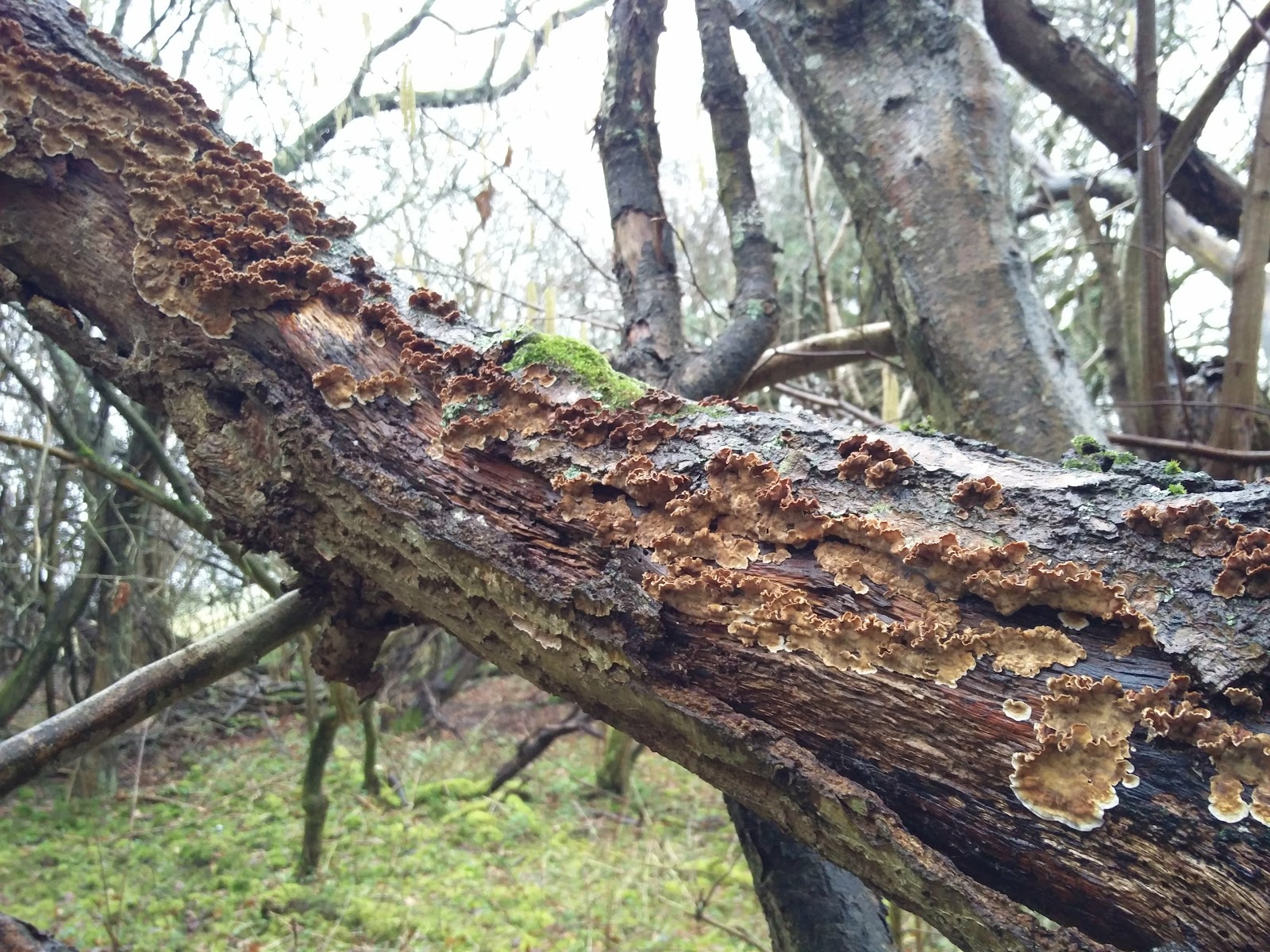
I wasn't expecting to get any more species from the Big Beech that day, so when Michael pointed out this crust fungus growing on one of the cut boughs I rather casually dismissed it as "probably Hairy Curtain Crust Stereum hirsutum". Boring.


It wasn't until I sat down next to it with my flask of tea that I realised it was something quite different. Not boring! 

Unless I am very much mistaken, this was Crimped Gill Plicatura crispa, making itself at home. 


The books say this species has a northern distribution, but we've come across it a few times of Sussex Fungus Group forays, so I think it must be establishing itself down south.

I think that brings my complete Big Beech list to around 21 species, albeit a few are not confirmed.
  1. Splitgill Schizophyllum commune (14/2/2016)
  2. Beech Woodwart Hypoxylon fragiforme (14/2/2016)
  3. Possible Cosmospora arxii (14/2/2016) - not confirmed
  4. Porcelain Fungus Oudemansiella mucida (9/10/2016)
  5. Oyster Mushroom Pleurotus ostreatus (11/12/2016)
  6. Beech Jellydisc Ascocoryne sarcoides (11/12/2016) - not confirmed
  7. Bitter Oysterling Panellus stipticus (14/01/2018)
  8. Small Stagshorn Calocera cornea (14/01/2018)
  9. Jackrogersella cohaerens (14/01/2018)
  10. Turkeytail Trametes versicolor (14/01/2018)
  11. Birch Mazegill Lenzites betulinus (14/01/2018)
  12. Hairy Curtain Crust Stereum hirsutum (14/01/2018)
  13. Clitopilus hobsonii (14/01/2018)
  14. Wrinkled Crust Phlebia radiata (14/01/2018)
  15. Smoky Bracket Bjerkandera adusta (14/01/2018)
  16. Ganoderma sp. (14/01/2018)
  17. Winter Polypore Polyporus brumalis (11/02/2018)
  18. Exidia plana (11/02/2018)
  19. Possible Common Jellyspot Dacrymyces stillatus - not confirmed (11/02/2018)
  20. Possible Leafy Brain Tremella foliacea - not confirmed (11/02/2018)
  21. Crimped Gill Plicatura crispa (11/02/2018)
Looking forward to seeing what else makes itself at home here!

For the record
Date: 11/02/2018
Location: The Big Beech, Rowland Wood, East Sussex
Grid reference: TQ514150

Sunday, 21 January 2018

Perfect weather for funguses


I headed out to Horton Wood in the drizzle yesterday: perfect weather for funguses!

On a fallen trunk, I found masses of this: an Ascocoryne species in its asexual 'anamorphic' stage.


I found a 'Key to Ascocoryne' on AscoFrance.com, here (Baral 2000) but it seems to require observation of the ascospores which I think are only present in the sexual 'teleomorphic' stage.

I've had a quick look under the microscope and all I can see is a tangled mass of hyphae and these tiny sausage-shaped things which I think are conidia.


They look right for A. sarcoides, based on images on the first-nature.com website (here) but I don't know if that's enough to confirm an identification.

UPDATE 10/02/2018 - Feedback from Nick Aplin over on the Sussex Fungus Group Yahoo! discussion group: "Yeah, that's the anamorph of Ascocoryne sarcoides. A. cylichnium doesn't have a (known) anamorph, A.inflata has a pale bubbly looking thing and A.solitaria has white blobs with dark stalks. They're all ID-able in the field providing the material is good enough. Conversely, the teleomorphs aren't necessarily ID-able in the field." 

Nice to be able to confirm this one as Purple Jellydisc A. sarcoides.

Pretty sure these are young fruit-bodies of Turkeytail Trametes versicolor; the pores underneath looked right for that species.


Fresh young Jelly Ear Auricularia auricula-judae were fruiting in several places; not just on Elder but also on other fallen deadwood (Ash?).


I spotted my first Spring Hazelcup Encoelia furfuracea of the year, growing on hazel and wedged up against an ivy stem; it was growing in at least three separate places along the length of the ivy, making me wonder what the connection is here between the fungus the ivy. Perhaps it just likes the sheltered microclimate?


I went on to find Spring Hazelcup Encoelia furfuracea on a few different stands of hazel around Horton Wood; as I did last year. I have submitted record details to the FRDBI so I can continue to keep track of the Small Dole Spring Hazelcup Encoelia furfuracea population.

I found a couple jelly fungi which I'm assuming are Exidia species. The first of which I think may be Exidia plana?

Growing on trunk of living hazel.
Growing on fallen branch.
Following 'A Key to British Exidia Species' (Roberts 2001) I think the bottom one is probably Exidia thuretiana, as I can see no mineral inclusions. I thought I'd check this by looking at the basidia which should be 'not stalked' (separating it from Exidia nucleata in which the basidia are 'distinctly stalked'). But I can't for the life of me find any illustrations which show what these stalks if they were there would look like.

Anyway, here's what the basidia look like. Do they look stalked to you?


And here are some other bits. I think the sausage-shaped things are spores.


UPDATE 10/02/2018 - Managed to get a second opinion on whether these basidia are 'stalked'. Nick Aplin has responded to say, "I think you have Exidia nucleata. For me the basidia do have stalks (with clamps at the base of the stalk not at the base of the basidium) ... I've stuck some arrows and notes to your images which might (?) make things clearer. I reckon E.thuretiana tends to be a bit more cloudy and resupinate-like, but others might disagree. Shame there's not much reliable info on these species on the web."

Thanks to Nick Aplin for the annotations. I can totally see the clamp!
I also came across this: Common Jellyspot Dacrymyces stillatus.


Having spent ages last weekend trying to find some D. stillatus spores, without success (here), I reluctantly tried again with this specimen. This time I spotted the spores instantly and found they show the four compartments separated by cell walls ('septa') nicely. These spores are also the right size for D. stillatus, being around 17 microns long by 6 microns wide. So I think I can confirm the ID this time.


And having spent quite a bit of time recently looking at the different Yellow Brain Tremella species, I'd be inclined to call this one Tremella mesenterica.


There were some interesting resupinate fungi around too.

I think this is Bleeding Oak Crust Stereum rugosum on the fallen oak.


In these damp conditions you can see how, when you cut it, it bleeds.


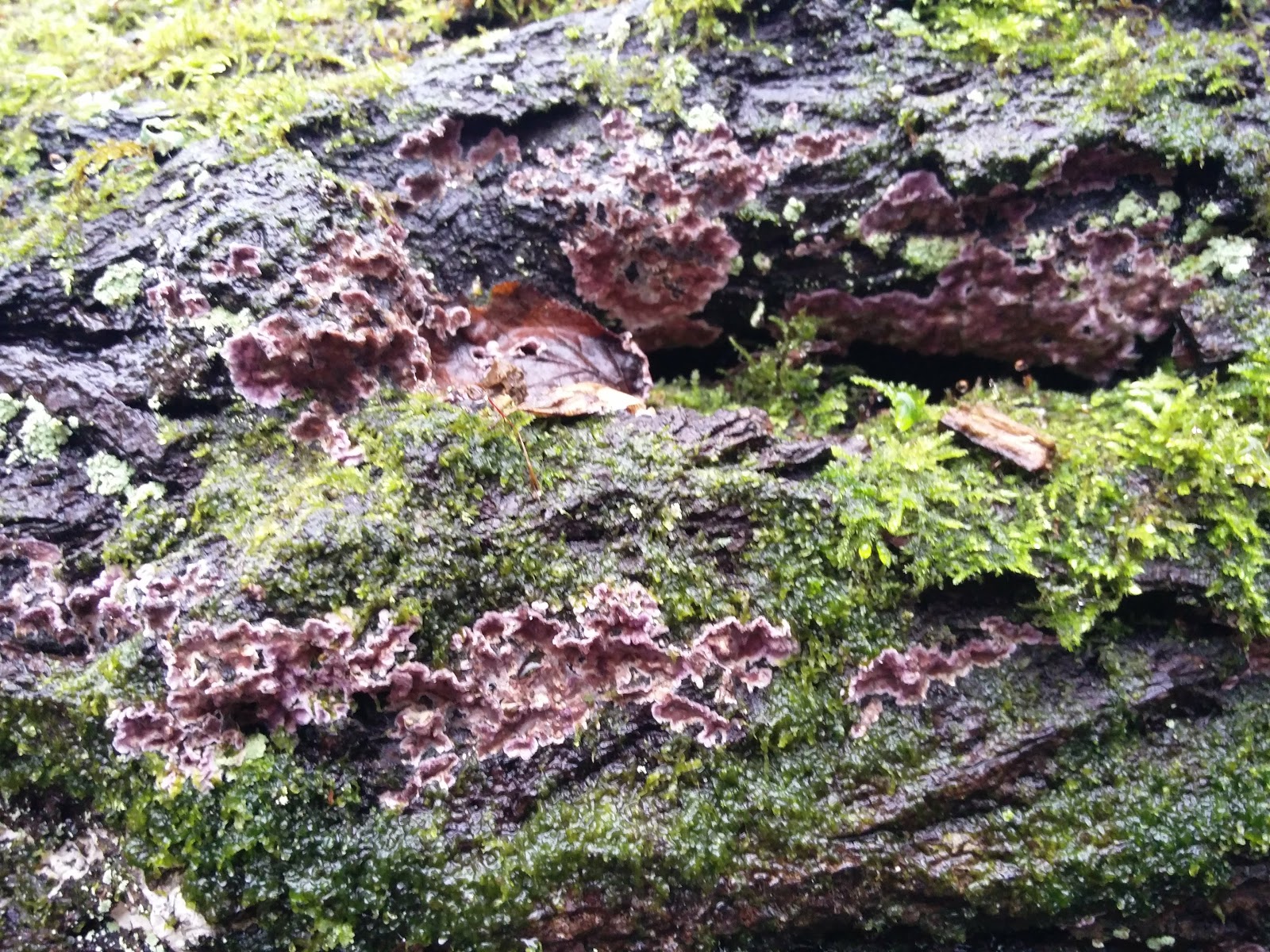
I found lots of Silverleaf Fungus Chondrostereum purpureum on an old willow.


This on a fallen oak branch (?) looked very interesting, but fairly well rotted, so I didn't take a specimen. It came away from the substrate in patches when touched.


I'd be interested to know if anyone's got any ideas on what this could be.


References

Baral, H.O., 2000, 'Key to Ascocoryne', www.ascofrance.com, URL: www.ascofrance.com/uploads/forum_file/5598.doc

Roberts, P., 2001, 'A Key to the British Exidia Species', Field Mycology, Vol 2(4), URL: https://doi.org/10.1016/S1468-1641(10)60535-X

For the record
Date: 20/01/2018
Location: Horton Wood, Small Dole
Grid reference: TQ208127 (site centroid) 

Records entered into FRDBI 07/09/2018

Sunday, 14 January 2018

The fallen beech

I returned to a favourite spot today: the fallen Beech in Rowland Wood.


This is my third year hunting for fungi on the remains of this big old tree (1). I first started looking in 2016 (here), just over two years after it had blown down. Back then the trunk and most of the boughs were still tightly covered in bark. Wood Wart Hypoxylon fragiforme swarmed across the surface.

Butterfly Conservation has undertaken some major management work in Rowland Wood this winter which has involved enabling access by machinery; it was therefore necessary to move the fallen trunk which had been blocking one of the main rides. I was really pleased to see the two halves have been placed adjacent to the ride in the same orientation and aspect as they were before to provide as much continuity as possible for the organisms which have made their home here.


While much of the tree still has its covering of bark, in many places it is starting to cleave away. At the broken end of the trunk, decomposers have been busy consuming and demolishing the heartwood.


A large patch of Bitter Oysterling Panellus stipticus is growing on the exposed surface.


I found more of it squeezed into a crack; presumably taking advantage of the moisture and access to all that nutritious wood.


On the upper surface of the main trunk, which must take the heaviest battering from the rain, the bark has fallen away. A tiny spindly orange fungus has taken up residence here: Small Stagshorn Calocera cornea?


The black fruit bodies of woodwart – presumably Beech Woodwart Hypoxylon fragiforme – still swarm across the boughs.


And I think this must be more of the same, spreading across the surface of that same bough, where the bark has fallen away; growing in a slightly less clustered form.


UPDATE 16/01/18 – Nick Aplin has responded to my post on the Sussex Fungus Group Yahoo! Group to advise that this looks like it should be Hypoxylon cohaerens (now Jackrogersella cohaerens, having been moved to a new genus last year (2)), rather than H. fragiforme.

If I've understood correctly, a feature of the genus Jackrogersella (formerly Annulohypoxylon, formerly Hypoxylon) is the 'papillate ostioles' (nipple-like pores) of the fruit bodies, which you can see here:


Here's what they look like in cross section.


Of the similar-looking species in this genus, J. cohaerens is apparently restricted to Beech Fagus; so it does seem likely that is what I've got here. There is a key in Wendt et al's paper (2) but – if I'm reading it right – the only observable feature which clearly separates J. cohaerens from J. multiformis is the length of the germ slit in the spore. I can't make out a germ slit at all, let alone see how long it is.


Something like Purple Jellydisc – an Ascocoryne species – was making itself at home on the cut end of one of the boughs.


On a damp log in a sheltered spot on the ground, I spotted Turkeytail Trametes versicolor (top) growing alongside Birch Mazegill Lenzites betulinus (bottom).


I think this is some more Birch Mazegill Lenzites betulinus, viewed from underneath.


On another of the cut ends there was a patch of Hairy Curtain Crust Stereum hirsutum


And tucked away under a loose chunk of bark I found these oysterlings – a Crepidotus species – enjoying this nice sheltered spot.


CORRECTION 16/01/17 - Nick Aplin suggested that the gills on this collection look rather pale for Crepidotus and it could be something like Clitopilus hobsonii

I was under the mistaken impression that Crepidotus is a genus that I could actually recognise, but it turns out there are a number of confusion species in different genera, as illustrated in a helpful article in Field Mycology: 'NOT WITHOUT A MICROSCOPE: Look-alike species of Cheimonophyllum, Clitopilus, Crepidotus and Entoloma' (3).

These little white beauties tested my microscopy skills to the limit, but I got there in the end.

The gills were covered in 4-spored basidia; and I couldn't see any cheilocystidia.


The spores were the right shape and size for C. hobsonii.

400x magnification. Mounted in water.
1000x magnification. Stained with PlaqSearch and mounted in water.

And the clincher I managed to observe the angled (~ decagonal) outline to the spores, in polar view.


I think this is sufficient information to confirm the collection as C. hobsonii. With thanks to Nick Aplin for the tip off!

The books say you're supposed to be able to see ridges running down the length of the spores: I couldn't make these out at all. But there are quite a few micrographs purporting to be of C. hobsonii spores online and most of these don't show the ridges either; I think they must be just very difficult to observe.

On the freshly cut surface of the main trunk, Wrinkled Crust Phlebia radiata was beginning to spread.


While on the north side of the trunk, Smoky Bracket Bjerkandera adusta was growing in profusion...


... with its distinctive grey pores.


I was intrigued by the very hairy surface of this fruit body, which had white pores underneath. The books say the upper surface of Smokey Bracket Bjerkandera adusta can be felty, becoming smooth. So perhaps a particularly felty example is what I'm looking at here.


Oyster Mushrooms – a Pleurotus species – were forcing their way through the bark in places.


And I loved these, but I couldn't say what they are; they were really tiny, just a few millimetres across.


Last but not least, I should also give a mention to this old thing, growing at the base of the standing trunk: one of the Ganoderma species (either Southern Bracket Ganoderma australe or Artist's Bracket Ganoderma applanatum).


I make that 13 different species on that one big old Beech.

And this inconspicuous little brown job was growing in the ride adjacent. 


After intensive investigations, I'm inclined to call this one Scurfy Twiglet Tubaria furfuracea.

Clockwise from top left: Gills & tan-coloured spore print; spores; cheilocystidia; basidia (4-spored)

Walking through the rest of Rowland Wood I didn't find much else.

This raspberry-coloured slime mould was very spectacular, growing in one of the rides that the mulcher had recently driven through.


And I think this is probably Common Jellyspot Dacrymyces stillatus providing a tiny splash of colour on the logs by the parking circle.


I've spent ages trying to find something that looks like D. stillatus spores (which wikipedia says look like this) but all I can find is this sort of thing. Hyphal fragments, maybe?


On the same log, a white slime mould was busy fruiting inside a small crevice.


Here's a small sample five hours later, under the stereomicroscope. It's changed colour!


Have sought some help over on the British Slime Moulds Facebook page with the slime moulds; apparently I need to wait for them to mature to get an identification.


(1) I found an interesting article in Mycologist (Vol. 10, part 1, 1996) on 'The breakdown of a beech tree - The first five years' by G. A. Fenwick. URL: https://doi.org/10.1016/S0269-915X(96)80047-4

After 5 years the author found the tree had been colonised by a total of 29 different fungi; so I reckon finding 13 species on just one visit to the Rowland Wood beech tree isn't bad! 

(2) Wendt et al., 2017, Resurrection and emendation of the Hypoxylaceae, recognised from a multigene phylogeny of the Xylariales, Mycological Progress, URL: https://doi.org/10.1007/s11557-017-1311-3


(3) Delivorias & Gonou-Zagou, 2011, NOT WITHOUT A MICROSCOPE: Look-alike species of Cheimonophyllum, Clitopilus, Crepidotus and Entoloma, Field Mycology, URL: https://doi.org/10.1016/j.fldmyc.2011.03.005

For the record
Date: 14/01/2018
Location: Rowland Wood
Grid ref: Big Beech is at TQ514150; Raspberry-coloured slime mould at TQ512151; Tiny orange fungus and the other slime mould at TQ515148

Records entered into FRDBI 07/09/2018