Sunday, 20 March 2016

Bog Beacon

Small stream that runs along the southern edge of the plateau at Park Corner Heath, looking east towards the pond.
It's fairly common knowledge among the volunteers involved in managing Butterfly Conservation's Park Corner Heath and Rowland Wood reserves, near Lewes, that one of the visual treats you can look forward to here, as Winter turns to Spring, is the fruiting of the Bog Beacon Mitrula paludosa.

As the Brimstone butterfly emerges from hibernation to patrol the woodland rides, looking for a mate, the Bog Beacon arises also, in the dampest places, to put on its own reproductive display. We saw crowds of them this morning along the stream which borders the southern edge of the plateau at Park Corner Heath (pictured above).

Over the years Butterfly Conservation volunteers have put in several small dams to slow the flow along this stream and create a series of small pools. The work was done primarily to improve the habitat for dragonflies and damselflies, but seems to have also created ideal conditions for Bog Beacon.
Bog Beacon habitat
Bog Beacon doing whatever it is that Bog Beacon does.
Over in Rowland Wood there's another site where the Bog Beacon reliably appears – a particularly wet ride which runs between the lake and the Big Beech.

Wet woodland ride in Rowland Wood, where Bog Beacon occurs.
And here's a little gang from that Rowland Wood population, up close:


Being new to recording fungi, I tend to assume that if *I've* managed to find and identify a species, it's probably something fairly common. So I was surprised to discover that, while this species does feature in the Collins Complete (photographic) Guide, it doesn't get the slightest mention in the Collins (illustrated) Fungi Guide – although the latter does include a selection of "the more common, conspicuous, large, interesting and/or distinctive" ascomycetes.

Well, this looks pretty conspicuous, large and interesting to me – so perhaps it's been left out because it's not very common?

I looked on the British Mycological Society's FRDBI database online and it includes only two records of M. paludosa from East Sussex: One from Vert Wood (part of the same woodland complex as Park Corner Heath & Rowland Wood) in 1967; and one from Chelwood Gate in 1979. But the species must be more widespread than the FRDBI records suggest because Googling "Bog Beacon Sussex" brings up a bunch of other records and photographs of this charismatic species.

Worth sticking the record in then!

For the record
Date: 20/03/2016

Location: Park Corner Heath
Grid reference (for M. paludosa): TQ510147

Location: Rowland Wood
Grid reference (for M. paludosa): TQ514150

Entered into FRDBI: 13/02/2017

Friday, 18 March 2016

Counters Gate

After picking up my new fungi books last Saturday, we drove over to Counters Gate near Goodwood for a walk up through the woods of Eastdean Park / Charlton Park – heading in the direction of East Dean.
Looking east from the public footpath, into Eastdean Park.


Walking through the coppice woodland (SU8911) the first fungus I came across, growing on hazel, was this:
Not a very good photo, but it's a pale, thin bracket fungus – velvety on top with pores on the underside. In a radical break with tradition, I'm not going to say, "Yeah, I think it's Turkeytail." My guess is this is different Trametes species – either T. hirsuta or T. pubescens (if only I knew how to tell the difference).

I'm in a similar fix with this next one. It's the same sort of colour as the previous fungus but has a flatter and smoother fruiting body, and is considerably less hairy. Perhaps this is T. pubescens and the one above is T. hirsuta. They're similar species apparently, but T. pubescens is more "finely silky or velvety".

And then a few I think I can do...
Birch Polypore Piptoporus betulinus
King Alfred's Cakes Daldinia concentrica
Glue Crust Hymenochaete corrugata
The next one puzzled me for a moment, because it was growing in this ear-like form, similar to Jelly Ear Auricularia auricula-judae, but almost black. I think it's actually another example of Witches' Butter Exidia glandulosa; the Collins (illustrated) Fungi Guide says the fruit body is "initially cup- or ear-like" and then grows into the distorted forms I've seen before.

The path eventually comes out into a clearing surrounded by mixed woodland of Beech and Oak (SU8912).

This great windblown Beech looked to be providing some excellent fungi habitat...

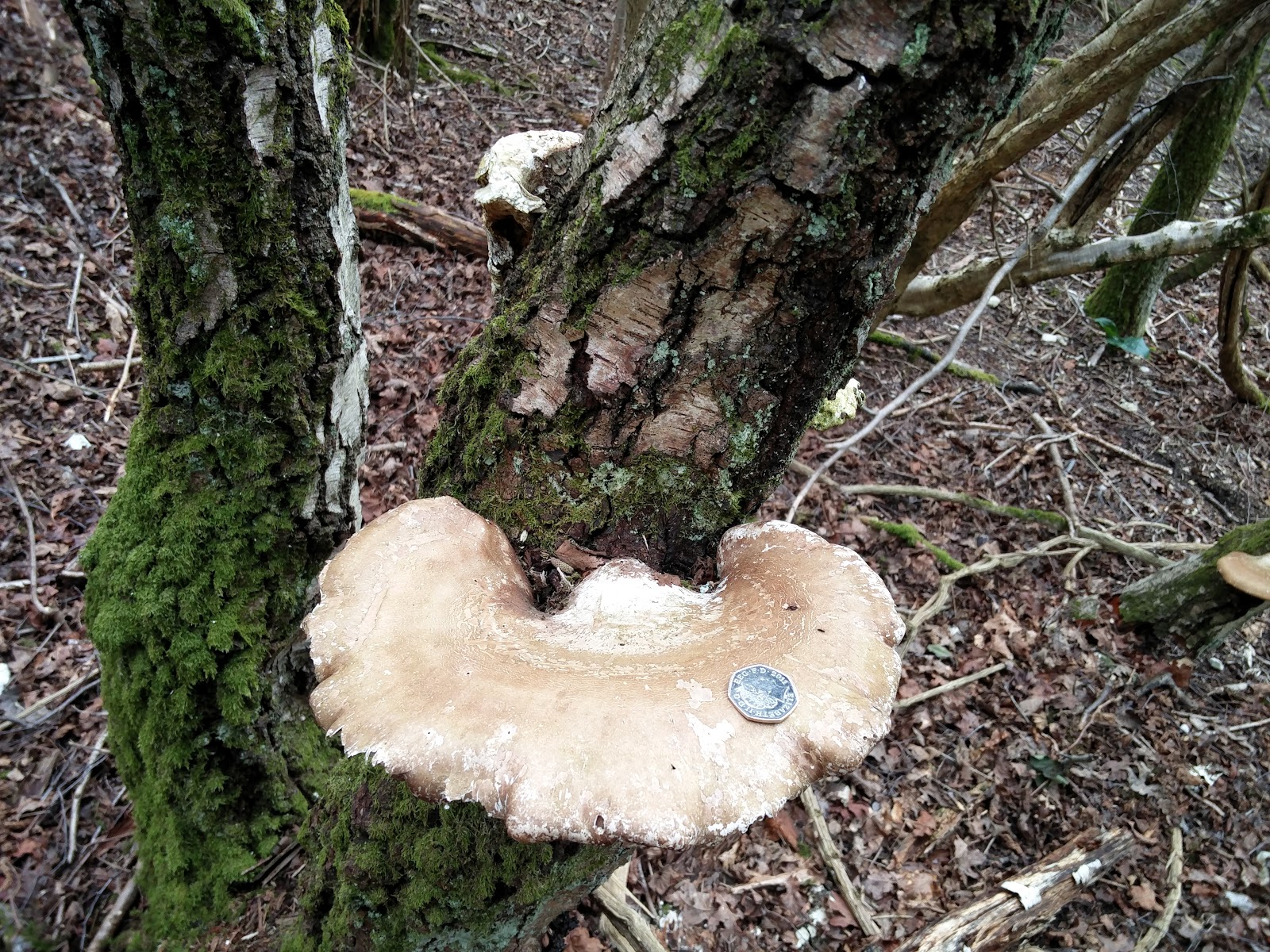
... including for this bracket fungus. I reckon this is a Ganoderma but there are several that look alike and are much confused: Artist's Bracket G. applanatum and Southern Bracket G. australe being the two which are most commonly found on Beech. There's also the Beeswax Bracket G. pfeifferi which apparently has a resinous or waxy surface that can be "melted with a lighted match". So, something else I should be carrying around in my bag of fungi-hunting apparatus – a box of matches.

I got quite excited about finding this rich brown crust fungus, growing on Oak, as I think it's another new species for me: Oak Curtain Crust Hymenochaete rubiginosa.
 

It was growing above head height and the light was low, so another terrible photo...


... but you can see it's growing tightly against the wood where the bark has come off and forming tiers of overlapping brackets, which is right for H. rubiginosa. The book says you should be able to see "fine bristly hairs" on the upper surface, with a hand lens, but I can't.

I also saw lots of this going on – another crust fungus the colour of my spare room. I was hypothesising the other week that this might be a Peniophora species. But I've got a new theory this week. The Collins Complete (photographic) Guide says that Glue Crust Hymenochaete corrugata can look similar to resupinate species of Peniophora, so maybe it's that.

Gonna need another bigger book for all these resupinate characters! As well as some microscopy skillz.

For the record
Date: Saturday 12 March
Location: Eastdean Park / Charlton Park, north of Counter's Gate
Grid reference: SU8911 (coppice woodland) and SU8912 (the mixed woodland)
Entered into FRDBI: 13/02/2017

Thursday, 17 March 2016

Funga Nordica

Funga Nordica
A few weeks back, after I'd spent much of an afternoon struggling to identify a mushroom I found at Park Corner Heath (which I eventually concluded *might* be a Psathyrella species), I asked Martin Allison, the Sussex County Recorder for Fungi, how one goes about putting a name to a species such as this:

"You're going to need a bigger book," Martin replied. And the book he recommended was Funga Nordica. (Actually, Martin's advice was more along the lines of: You're going to need a lot of bigger books, and most of them are very expensive, but the place to start, if you want to get into serious mycology, would be Funga Nordica.)

Imagine then my disappointment upon discovering that Funga Nordica is out of print, sold out everywhere, and IMPOSSIBLE to get hold of.

Some weeks later, I received an email from another Sussex mycologist, Howard Matcham, who said he's been enjoying reading this fungi blog and, as he is focussed on studying other, even-more-obscure, forms of life these days, asked if I would like to have his copy of Funga Nordica – to give me "a nice start in my mycological career".

WHAT LUCK!

Of course I replied, "YES PLEASE!".

And that wasn't it: Howard also had a copy of Collins Fungi Guide he was offering to give me – the illustrated one. This too had been on my wishlist ever since it was recommended to me by Graeme Lyons, as I gather it includes more comprehensive coverage of all the UK species than my other field guides.

My cup runneth over! And my bookshelves are runneth-ing over too, so I've had a bit of a re-organise. Here is my new "Mycology" section:


Sunday, 6 March 2016

Trip down Marley Lane

To Haslemere today for lunch and, amazingly, after a particularly delicious plate of roast lamb and a glass of beaujolais (pronounced "bow - joll - iss" by Dad, because he has a reputation to maintain), I managed to convince my dear parents that they would REALLY like to spend Mother's Day afternoon wandering around Marley Common, looking at bits of dead wood.

Yes, Reader, I hail from Over The Border: Haslemere. Nestled up against Surrey's boundary with Sussex and Hampshire, people from Haslemere reach parts of Sussex that the Sussex-dwelling folk don't tend to get to very often. And so it was today: We headed south, out of Haslemere, to Marley Common. To Sussex! And the site of one of my earliest fungus forays.

In truth I never went 'up Marley' very often when I was growing up in Haslemere. Because, for a walk, it's just not quite as good as Black Down. But apparently it is rather good for fungi; so I've got a feeling I'll be spending a lot more time here in future...

We saw various aged bracket fungi which I moved swiftly past because I still have no idea what I'm doing with bracket fungi (other than saying, "yeah, I think it's Turkeytail," repeatedly, upon encountering almost every bracket fungus I see).

I attempted to impress Mum by showing her what-I-think-was Peniophora quercina, but she just thought it looked like a bit of dead bark. And I'm not sure excitedly pointing out that it was "SLIGHTLY CRAZED!" really convinced her of its fungal nature.

She was fairly impressed with these though. More tiny red beads!
 I'm going to go out on a limb here and say these may be the anamorph of another Nectria-like species – like what I found (and misidentified) in Hoe Wood the other week. It was growing on one of the upright branches of this fallen (birch?) tree:

Nick Aplin (Sussex Fungus Group) has said he'd be interested to receive collections like this from Sussex, so looks like I'll be down the Post Office again tomorrow.


For the record
Date: 06/03/2016
Location: Marley Wood
Grid reference (for the Nectria-like species): SU890309

Sunday, 28 February 2016

A dry bottom


Typical countryside scene, Sussex, February 2016

Officially bored of trudging through mud now, so headed out with Michael and our friend Laurie up the steep northern scarp slope of the Downs, over Blackcap, and down into Ashcombe Bottom.

Ashcombe Bottom is covered in mixed deciduous woodland, growing right on top of the chalk. As a result it's much drier underfoot than my usual haunts in the Adur valley. But its sheltered position must offer a damper climate through the year, as the trees here are festooned in mosses and ferns - giving the place a slightly enchanted feel.


I'm calling that Turkeytail Trametes versicolor, again, ...

... and I think this next one is another example of Hairy Curtain Crust Stereum hirsutum, as it's got the smooth underside and hirsute, almost felt-y, upperside:

I foolishly forgot to check what kind of tree it was growing on, and this photo isn't really helping me to settle that question:


There are a few different Stereum species, some of which bleed red when damaged, and I am faintly wondering, given its fairly subdued colour, whether this might be Stereum rameale. But my books say that's generally found on slender branches and twigs and has a smoother upper surface.

In the relative dryness of Ashcombe Bottom, I got to see a couple of 'dried out' versions of jelly species I've become acquainted with recently, including:
Jelly Ear Auricularia auricula-judae
Witches' Butter Exidia glandulosa

And we came across this, which I think is a dried out example of Peniophora quercina (like, actually Peniophora quercina this time, not Exidia thuretiana). You can see the margin is rolled back, revealing a dark underside – that is apparently a distinctive feature of Peniophora quercina:


Saw this too, growing on hazel, which looks similar but I think probably a different species:


The colour looks like it would be quite at home on a Dulux paint chart – some dusky shade of magnolia – in fact almost identical to the colour we painted our spare room where I sit and write this blog: Gentle Fawn. The other feature to note is that it's slightly crazed (and I mean crazed as in covered in fine cracks, not crazed as in CRAZED!!!!!). My guess is it's another Peniophora species but without a proper key to the different UK species I'd be loath to say which one, as there are a number which look very similar.

Also on the hazel were swarms of woodwart; I'm very tempted to call them all Hazel Woodwart Hypoxylon fuscum and be done with it. But I think there are actually a few Hypoxylon species that can be found on hazel so I might have a go at keying them out.

Also saw plenty of King Alfred's Cakes Daldinia concentrica:


It was shortly after we saw those that Michael called me over to see an impressive display of Birch Polypore Piptoporus betulinus, on a fallen birch limb.


I've seen these before but was still struck by how MASSIVE they are. That's a 50 pence piece:


Last, and least identifiable, was this flat, cinnamon-coloured and crusty-looking thing:


I think this is another Phellinus species, similar to the Phellinus I found in Rowland Wood which I've been bothering Martin Allison (the County Fungi Recorder) with.

There are two species in my (not complete) Collins' Complete Guide which look like this: Rusty Porecrust Phellinus ferruginosus and Cinnamon Porecrust P. ferreus. Microscopic examination of the spores is necessary to separate the two with certainty – which I gather is easier said than done as specimens are often not inclined to give up any spores. Perhaps I'll leave it on a piece of glass in the spare room and see what happens.

UPDATE 13/03/16 - I left it on a piece of glass in the spare room for two whole weeks. Nothing happened.

POSTSCRIPT 08/06/2016 - Have received an email from Peer Corfixen (who I guess must be this Peer Corfixen, of the Natural History Museum of Denmark) advising me that "P. ferruginosus have big (300 mm long) mycelialsetae below fruitbody and in the wood." 

So that's something to look out for next time I  come across a rusty-coloured porecrust.

Thank you, Peer Corfixen. Amazing to think that real people - real mycologists! - are reading this.

For the record
Date: 28/02/2016
Fungi finders: Clare Blencowe, Michael Blencowe & Laurie Jackson
Location: Ashcombe Bottom, near Lewes
Grid reference: TQ3711
Entered into FRDBI: 13/02/2017


Saturday, 27 February 2016

Field notes

Field notes 23 October 1988
Mum's just sent me this in the post: Field notes, by me, aged 9.

23.10.88

1) found bacalors [sic] button on fallen tree.

2) Found purple and yellow white toadstool on pine leaf litter.

3) Found toadstool with chunky stem and white gills.

4) found white toadstool under fern.

5) found brown toadstool under Fern.

6) found white toadstool with fishy smell. [crossed out?]

Someone must have coached me in the art of field observation, as I was clearly doing my best to record a range of identification features including substrate (what it was growing on) which is so critical in identifying fungi.

Only the first observation is identified to species: Bachelor's Buttons. Although, curiously, this isn't a common name which now features in the UK Species Inventory. Google indicates it has been in currency as another name for Black Bulgar Bulgaria inquinans - one of the Ascomycetes - so I imagine it must have been told to me by some knowledgeable forayer. And I remembered it, even though I couldn't spell it.

The arguments for and against common names are all here: They're memorable to the untrained ear. But they lack the precision of scientific names.

Looking back, there is some critical information missing from these field notes:
  • Where was I?
  • Who was I with? i.e. who was the determiner for those Bachelor's Buttons?
I must do better with my current attempt at field mycology. Because perhaps, years from now, I shall be looking back on this blog like I'm looking back at these field notes.

Any experienced mycologists care to hazard a guess as to what species (or genus) observations 2 to 6 might have been?

Saturday, 20 February 2016

Tricky (Trichia?)

Just a couple of species I haven't seen before in Tottington Wood today.

A quick poke around in that woodpile revealed these little mustard-coloured capsules on the underside of a log. I wonder if this is another slime mold (perhaps from the genus Trichia), like the one I found on the old beech tree at Rowland Wood.

Old stacks of cut hazel seemed to be providing some good bracket fungus habitat:
With those colourful bands of colour on a velvety upper side and a creamy-white underside covered in tiny pores, I'm tempted to call these thin brackets Turkeytail Trametes versicolor. But that seems a bit suspiciously easy.

After turning over one particularly old and past-it looking Trametes sp., I found this:
I think this rather fetching ruby colour is another fungus, growing on the bracket fungus. Here's what it looks like under the microscope:
Perhaps another Cosmospora species, like the red beads I found on Beech Woodwart Hypoxylon fragiforme?

I'm going to "phone a friend" on this one and post it in the Sussex Fungi Yahoo group.

UPDATE 13/03/16 - Nick Aplin of Sussex Fungus Group was kind enough to take a look at these two species I found in Tottington Wood.

According to Nick, the first species is Trichia varia (quite chuffed that my guess at genus was correct) – "quite a common species which is characterised by a helical capillitium of +/- two spiralling bands which are often a bit 'lopsided'." And here's Nick's photo showing that helical capillitium:

The second species is Hypomyces rosellus, and Nick must have some super-duper microscope as he's produced this fabulous macro shot of it – a composite of 16 stacked images:

And here's another of Nick's photos, of some of its bits:


For the record
Date: 20 February 2016
Location: Tottington Wood
Grid ref: TQ215127
Added to FRDBI: 13/02/2017