Tuesday, 26 January 2016

Eyelashes: More complex than I'd realised

On the subject of that wacky Common Eyelash fungus that I found in the woodpile...

Turns out these are more complex than I'd realised. Literally. Nick Aplin of Sussex Fungus Group got in touch and explained that the Scutellinia are now thought to be a poorly-described "species complex". That means that what people used to think was one species (i.e. Common Eyelash Scutellinia scutellata) could be any one of many different species that all look very much the same. Unless you have a microscope and you know how to use it. And you've got the right identification key and you know how to navigate your way around that.

This is all getting well beyond my ken. Lucky for me, Nick has microscope, keys and know-how, and generously offered to take a look at my "Eyelash". (Yeah, we know it sounds weird.)

So one day a couple of weeks ago I went back to that woodpile for a specimen. I packed it carefully, along with that purply-brown blob, and popped it in the post.

After waiting a few days to get a spore print, Nick was able to get these photos of the identification features which show the fungus I found is Scutellinia crinita. The notes in brackets are his.

Hairs mounted in water (note rooting bases)

Asci mounted in water 


Ascospores mounted (and heated) in lactophenol cotton blue (note the fine ornamentation typical of this species)

Incredible, huh?

For the record

Observation date: 01/01/2016
Location: Tottington Wood
Grid reference: TQ216127

Detemined by Nick Aplin as Scutellinia crinita on 16/01/2016
Entered into FRDBI: 13/02/2017

Purply-brown blob: A postscript

Remember that purply-brown blob that fell off its log?

You probably thought that was the end of the story... But it isn't!

Because I picked up that purply-brown blob, put it in a little plastic box with some damp tissue paper, and popped it in the post to Nick Aplin of Sussex Fungus Group, who specialises in Ascomycetes.
Nick's confirmed that the purply-brown blob is indeed an example of Ascoryne sarcoides.

So there you go - the blob has a name.

Entered into FRDBI: 13/02/2017

Sunday, 24 January 2016

Spring Hazelcup

Today's find is a cracker! Well, I say "today's", husband spotted it on a walk through Horton Wood yesterday and took me to see it today.

The young fruit bodies, growing on hazel, look like funny little pouches:
... and then open up into these ragged little round dishes.
There's only one thing in the book that looks like this, and it's Spring Hazelcup Encoelia furfuracea.

The Collins' Complete Guide says it's "widespread but uncommon", and Jordan's Fungi describes it as "infrequent". So potentially an interesting find.

Here's another colony from the same patch of woodland today:

STOP PRESS!!! 
26/01/16
Just heard from Nick Aplin (Sussex Fungus Group) and Martin Allison (Sussex Fungi Recorder) that this record is officially "a good record" - they've never seen this in Sussex before, despite deliberate searching. And there are just a handful of previous records for this species in Sussex. This could be the first Sussex sighting THIS CENTURY!

So that's exciting. Must go back with a GPS and get a 10 figure grid reference.

For the record
Date: 24/01/15 CORRECTION - 24/01/2016
Location: Horton Wood, Small Dole
Grid reference: TQ208127 (site centroid)

Blobs, crusts, balls and brackets

I heard back from Malcolm Knight, Chair of the Tottington Woodlanders, last week - confirming that they'd be delighted for me to survey the woodland fungi and granting me permission to venture off the public rights of way, within the boundary of the Local Nature Reserve - as long as I tread carefully. Woohoo!

So I took advantage of another damp grey day yesterday to explore a couple of the coppice compartments a little further, and see what I could see.

First up, I found some blobby-looking white crust fungus growing on the underside of a fallen (birch?) branch. Intensive study of my reference books has confirmed: I don't know what this is.
A not-very-educated guess would be young growth of Wet Rot Coniophora sp. The Collins' Complete Guide describes Wet Rot as "Fully resupinate [attached to the thing it's growing on] ... initially small, rounded spots that coalesce to form large, irregular patches with a broad, fringed margin... cream at first, becoming ochre or dark brown and paler towards the margin." That seems to be the closest match I can find, but I could easily be in the wrong genus with this one.

Next I noticed a pale brown jelly fungus - seemingly fairly common on dead twigs, still hanging in the trees. The twigs all looked to be birch to me.
It reminded me of the Beech Jellydisc I was looking up the other day. But it definitely wasn't growing on Beech. Couldn't find anything in my books that quite matched the features I'd observed, so I resorted to Google (a terrible habit which I must train myself out of). Anyway, I found this blog from Lorn Natural History Group on Willow Jelly Button (which I found the other day) and Birch Jelly Button.

The description of Birch Jelly Button Exidia repanda matches very closely with what I found today, but that species doesn't feature in any of the three reference books I currently possess. So, one to pursue at a later date, when I have more books.

Fungus number three today was this, growing on a birch log pile:
I saw these black spots growing on birch bark and thought, "Ah! That'll be Birch Woodwart again!" But, of course, it isn't. Birch Woodwart has much larger, elongated fruit bodies. I'm guessing this is some kind of Barkspot Diatrype sp. But the books I've got don't make it very clear how you separate the similar D. disciformis and D. quercina species. Looking at it through a hand lens you can see the spots are covered in tiny pores, like a well-used pin cushion.

Next an easy one:
CRAMP BALLS! Or King Alfred's Cakes Daldinia concentrica.

My fifth find was, I think, another example of Hairy Curtain Crust Stereum hirsutum. This one did look really hairy:
... found growing on another (oak?) log pile:

Last, and least identiable (by me), was this small bracket fungus - somewhat past its best:
It looks a bit like a tiny Bitter Bracket Postia stiptica, but the book says that species is only rarely associated with deciduous trees. So, er, I'm going to pass on this one.

UPDATE 26/01/2016 - Nick Aplin (Sussex Fungus Group) says that fungus number two does look like Exidia repanda, apparently quite a poorly know (but fairly common) species. 

He's also explained that the 'black bits' on Birch aren't Diatrype (which forms quite a flattened, coin-like stroma). They could be Hypoxlon fuscum or Annulohypoxylon multiforme (the latter is only 'elongated' when it is guided through the horizontal cracks in the Birch bark - when there are no cracks it's usually more random). But microscopy is needed to confirm the identification.

I must figure out how to use my microscope!

For the record
Date: 23/01/2016
Location: Tottington Wood
Grid reference: TQ216127 
Entered into FRDBI: 13/02/2017

Sunday, 17 January 2016

Tippex fungus on Old Man's Beard

Found up on Graffham Down, in mixed woodland: It's some fungus that looks like Tippex, growing on a woody stem of Old Man's Beard Clematis vitalba.

There's only one thing in my books that looks like Tippex, and that's Elder Whitewash Hyphodontia sambuci. But the books say it's supposed to live on the wood of broadleaf trees, favouring Elder. Doesn't say anything about it growing on Clematis.

Uh oh! Wikipedia says, "H. sambuci consists of a complex of species."  I think that means there might be a whole bunch of different species which all look like Tippex. Ain't nobody got time for that.

For the record
Date: 17/01/2016
Location: Graffham Down
Grid reference: SU920163

Turkeytail

  
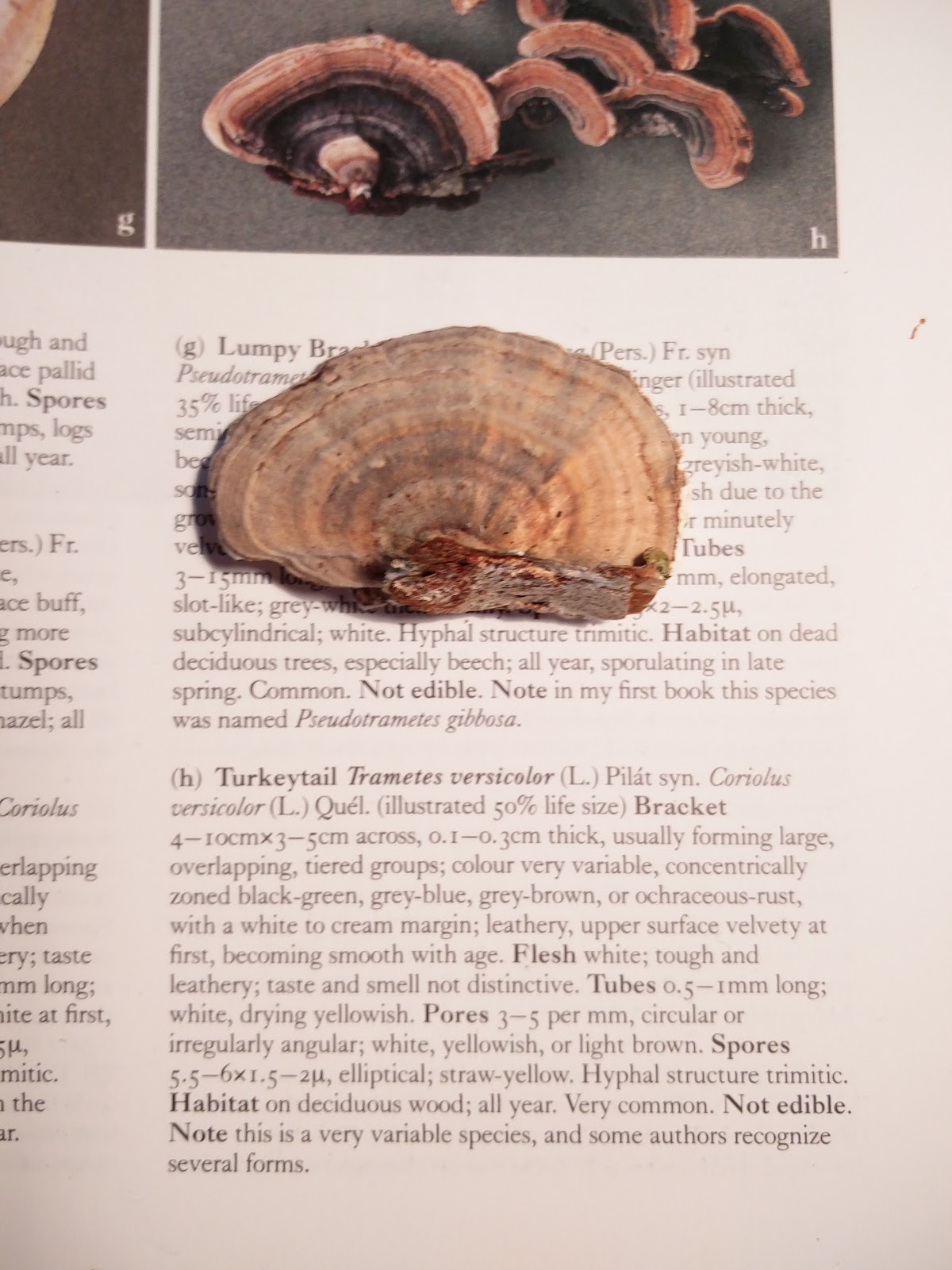
Loitering in Graffham this morning, waiting for folk to gather for a Graffham Down Trust work party, I noticed this sociable mass of bracket fungus.

The persistent sleet made it difficult to get a decent photograph. So we just have this, for the record - making it seem rather whiter than the image in my memory.

It's a good match for Turkeytail Trametes versicolor in Roger Phillips' Mushrooms:
  • usually forming large, overlapping, tiered groups
  • 0.1 - 0.3 cm thick (i.e. not very thick)
  • underside white, yellowish or light brown with 3 - 5 pores per mm
  • colour very variable and concentrically zoned with a white to cream margin
  • velvety upper surface
It does have a lovely velvety feel to it. (And I can't see any hairs which would make it Trametes hirsuta).

The book says Turkeytail Trametes versicolor is also very common and found on deciduous wood, all year, which is promising.

BUT there's a note which adds, "this is a very variable species, and some authors recognise several forms." Reckon that could mean we're in dodgy territory, trying to pin this one down to species just from the visual characteristics you can observe in the field.


For the record
Date: 17/01/2016
Location: Graffham
Grid reference: SU926168

Wednesday, 13 January 2016

My kind of microbeads

Went back to the tree that's home to what-I-think-is Panellus stipticus the other evening, on my way home from work, to see if I could catch it glowing. Sadly still no sign of any bioluminescent tendencies. But when I pulled the branch down to get a closer look, I noticed my fingers were left covered in charcoal-like dust. Intriguing!

I returned today, to take a look in the daylight...
... and I discovered the underside of the branch (which is only about 4 or 5 cm wide) is also home to a patch of tiny ashen-white globes - each about 1 mm across. You can just about make them out in this picture, although they're incredibly fragile and many are broken.

I did my best to get a specimen and managed to get home with a couple of the tiny spheres almost intact. Hard to do justice to with a cameraphone down a microscope, but they look AMAZING. Like perfectly round microbeads...
And inside they have these filamentous structures which, in the more intact specimens, hold even-more-miniscule round black capsules. Slightly reminiscent of the inside of a pomegranate:
It must be these black capsules that leave the charcoal-like dust on ones hands. Spores? I tried looking at them under the slide microscope but either I'm terrible at microscopy, or they do just look kind of round and black.

The other feature I managed to make out, which you can just about see here, is that the globes seem to be sitting on the end of short, hairy stalks:
BUT WHAT ARE THEY???

Dunno.

My best guess would be the remains of the fruiting bodies, or 'sporangia', of a slime mold.

Slime molds are like nothing else. They are not fungi. But they're really cool so I'll let them be in my blog.