Tuesday, 17 October 2017

Another load of Lepiotas


On the Sussex Fungus Group foray at Seaford Head (which I wrote about here) we spent some time fossicking about in the strip of scrubby woodland which flanks the eastern side of Hope Bottom. It was here that we came across some charming Dapperling Lepiota -like species: a genus which I was trying very hard to get to grips with the other week. So, in a show of mycological bravado, I offered to take the Seaford Head specimens home to ID.

Happily, via the magic of Twitter, I got some tips from mycologist Andy Overall which has helped; along with some pointers from Nick Aplin. I would have got completely stuck otherwise as working my way through the keys in Funga Nordica has been hard going.

In terms of habitat, they were all found growing in soil in broadleaved woodland (dominated by hawthorn).

And they've all produced white spore prints.

So here's introducing...

Lepiota 1

Suggested ID, based on photo: Lepiota subincarnata

Cap: Pinkish brown, cracking into scales. Paler towards the margin.


Odour: some odour but not distinctive.


Gills: Medium spaced.

Stipe: Cylindrical; widening slightly towards the base. Pinkish; with girdles of colour towards the base.

Spores: Relatively small. All the ones I've measured are around 6 microns. The shape is fairly cylindrical which fits with L. subincarnata. They've turned yellow in Melzers reagent.

1000x magnification. 1 sub-unit ~ 1 micron. In Melzers.
1000x magnification. 1 sub-unit ~ 1 micron. In ammonia.
Pileipellis: The cap is made up of long elements but I've had a heck of a time trying to get a good look at them. There seems to be a mixture of long thin ones and shorter club-shaped ones.

1000x magnification. Stained with Congo Red.

1000x magnification. Stained with Congo Red.
So far these features seem like a reasonable match for L. subincarnata. That species should have club-shaped ('clavate') cheilocystidia.

At this point I realise I should have got my specimen in the dryer sooner than I did, as something's been munching the gills. I've done my best to salvage an in-tact piece of gill, and after several attempts I think I've found something that looks like a cheilocystidium.

Cheilocystidia: Clavate.


This has taken AGES. So let's agree that this one's Lepiota subincarnata and move on.

Lepiota 2

Suggested ID, based on photo: Lepiota grangei or L. griseovirens

Cap: Dark grey with grey-black scales.


Stipe: Grey, with dark grey-black girdles.


Gills: Medium spaced.

Spores: 9 - 10 microns long with a truncate, spurred base. Stain reddish-brown in Melzers reagent.


Pileipellis: Elongate cells. Not obviously septate.

400x magnification. Mounted in ammonia.
I think this might be showing 'incrusting pigment' in one of the pileipellis elements:

400x magnification. Mounted in ammonia.
Cheilocystidia: Irregular cylindrical, utriform to clavate. Loads of them!


These features seem like a reasonable match for Lepiota griseovirens.

Lepiota 3

Suggested ID, based on field observations: Cystolepiota seminuda


Cap: This is a really lovely little thing, with a dusty texture to the cap ('slightly pulverulent'). The margin is hung with ragged veil remnants.


Stipe: Dark purplish towards the base.

Spores: Are teeny weeny! Only about 4 microns long. (The spore print was almost impossible to see on the microscope slide, but I did get one.)


Cheilocystidia: Not present.

I think this confirms this collection as Cystolepiota seminuda.

Lepiota 4

Suggested ID, based on photo: Lepiota brunneoincarnata (?)


Here's what they looked like in situ.


Cap: Young caps a rich, dark brown colour, breaking into (floccose?) patches against a white background. Cap colour paler in larger, more mature fruit bodies.

Couldn't convince myself I could see any 'vinaceous' or purple shades which rather messed things up as far as working through the key goes.


Stipe: Cylindrical. White-cream and finely silky-fibrillose towards the cap. Very pronounced girdles of cap colour towards the base. No ring, or obvious ring-zone.


Gills: Free, crowded.


Odour: Not distinctive.

Spores: Length generally just under 10 microns. Width ~ 3.5 to 4 microns. Shape ~ ellipsoid, or slightly amygdaloid and flattened at one end (truncate). Dextrinoid.

1000x magnification. In Melzers reagent. 1 subunit ~ 1 micron.


Pileipellis: With long, cylindrical cells.

100x magnification.

400x magnification.
400x magnification.

I just managed to make out a clamp connection in this image which rules out a number of species. L. brunneoincarnata has clamps.

400x magnification (close up).

L. brunneoincarnata is also described as 'often septate' (i.e. having a wall between two cells). I  think this image shows the pileipellis elements to be septate.
 
1000x magnification.

Cheilocystidia: Very difficult to see! But I think these are clavate cheilocystidia on the gill edge.


Not sure what this is... A basidium?


In conclusion, it seems plausible that this collection is L. brunneoincarnata. However, two things are bothering me:
  1. The lack of a 'vinaceous tinge' to the cap.
  2. The shape of the spores, some of which look to me to be slightly truncate and not a perfect match for the illustration in Funga Nordica.
If it's not L. brunneoincarnata I don't know what it is, as I've ruled out various other species including:
  • L. pilodes, L. castanea and L. ignicolor – as these Lepiota species are all without clamps.
  • L. cortinarius I thought the spores looked a better match for this species, but L. cortinarius has a clavate or abruptly bulbous base which my collection doesn't.
Maybe I should put this on my Christmas list...


UPDATE 27/10/2017: It seems this mushroom may be something different, so it has been despatched to Dr A. Martyn Ainsworth, Research Leader in Mycology at Kew, for further examination. Hopefully I shall have an update on its identity in due course...

For the record
Date: 14 October 2017
Location: Hope Bottom, Seaford Head
Grid reference: TV508977

Collections retained for Lepiotas 2 & 4.

Sunday, 15 October 2017

Seaford Head - Saturday 14 October


I joined Sussex Fungus Group at Seaford Head on Saturday morning to see what fungi we could find on this iconic Sussex site.

Seaford Head is managed by Sussex Wildlife Trust with the help of a loyal band of conservation volunteers. Sussex Fungus Group members Janet & Jim Howell are two of those Seaford Head volunteers, so offered to guide us around the site. They explained that it has never been comprehensively surveyed for fungi, so any records we came up with would be a useful addition to the list.

Walking onto the reserve, the path is flanked on both sides by scrub. Here, growing on a couple of the Elders, on the old wood near the base, we found a few clumps of mushrooms. Clearly past their best.

The pale caps appeared dried out and had broken into irregular brown patches.


Underneath, the gills appeared to be a rich cocoa-brown colour – well dusted with spores; but in places, near the edge of the cap, the gills were a paler buff colour, suggesting the gills would have originally been paler when this mushroom was less mature.

I think I can also see the remains of a ring around the stem.


When we came across what appeared to be some fresher-looking specimens of the same species, Nick Aplin proposed a tentative identification of Poplar Fieldcap Agrocybe cylindracea.

Agrocybe is not a genus I'm familar with at all, so I'd meant to leave this species in Nick's capable hands to confirm. But it got left in my bag by accident, so I suppose I'd better have a look!

The first thing I noticed was lots of these spore-bearing structures – 'basidia' – all with four little prongs on the end.

1000x magnification. Stained with Congo Red.

On the gill edge I found what I think are cheilocystidia in a range of shapes from club-shaped ('clavate') to slightly skittle-shaped ('utriform').

1000x magnification. Stained with Congo Red.

1000x magnification. Stained with Congo Red.

The spores were quite variable in size, in the range of 8 - 12 microns long. I couldn't clearly make out a germ pore on the spores; but that might be because my microscope's not brilliant.

1000x magnification. Each sub-division on the scale is about 1 micron.

These microscopic characteristics all fit with Poplar Fieldcap Agrocybe cylindracea (= cylindrica). And they look pretty similar to micrographs of A. cylindracea which I found on a Belgian mycology website, here. So gives me no reason to doubt Nick's tentative field identification. I'll leave it to him to decide if he's happy to record it as A. cylindracea, with my microscopy.

The mushrooms we saw don't look anything like the examples of Poplar Fieldcap Agrocybe cylindracea that you see in the books and online photo galleries. But the descriptions do note that in dry weather the cap surface sometimes cracks and Roger Phillips, in his book 'Mushrooms', notes that the cap becomes darker brown with age. Funga Nordica describes the habitat as "on wood or wood chips of deciduous trees, especially [Poplar] and [Willows]". So – despite its common name
– that doesn't rule it out occuring on Elder.

That's the trouble with mushrooms they don't always look like the pictures! And they don't always grow where they're supposed to. We have had a dry couple of weeks in the run up to our foray at Seaford Head, so perhaps we just found a particularly dried up example of Poplar Fieldcap Agrocybe cylindracea.

Moving a little further on, we ducked into a patch of scrubby woodland.

Here we found an intriguing orangey-brown bracket growing on Blackthorn.


Underneath, the white pores were very attractively arranged with relatively thick partitions between them.


Nick Aplin identified this as Perenniporia ochroleuca: one of the Lost & Found Fungi project target species (described here). I see that the current distribution map includes a record from Seaford Head, recorded by A. M. Ainsworth in 2015. He beat us to it!

This little scrap of woodland turned out to be surprisingly rich in Lepiota (or Lepiota-like) species.

Lepiota 1. (Slight odour, but not very distinctive.)

Lepiota 2. (Odour quite strong, perhaps 'leathery'?)
Lepiota 3. Cystolepiota seminuda?
Lepiota 4. (No particular odour.)
In a brave show of confidence in my identification skills, it was decided that these should come home with me. So they will be receiving more of my attention soon!

Also in the woodland we found the remains of a couple of Giant Puffballs Calvatia gigantea sending forth their spores.


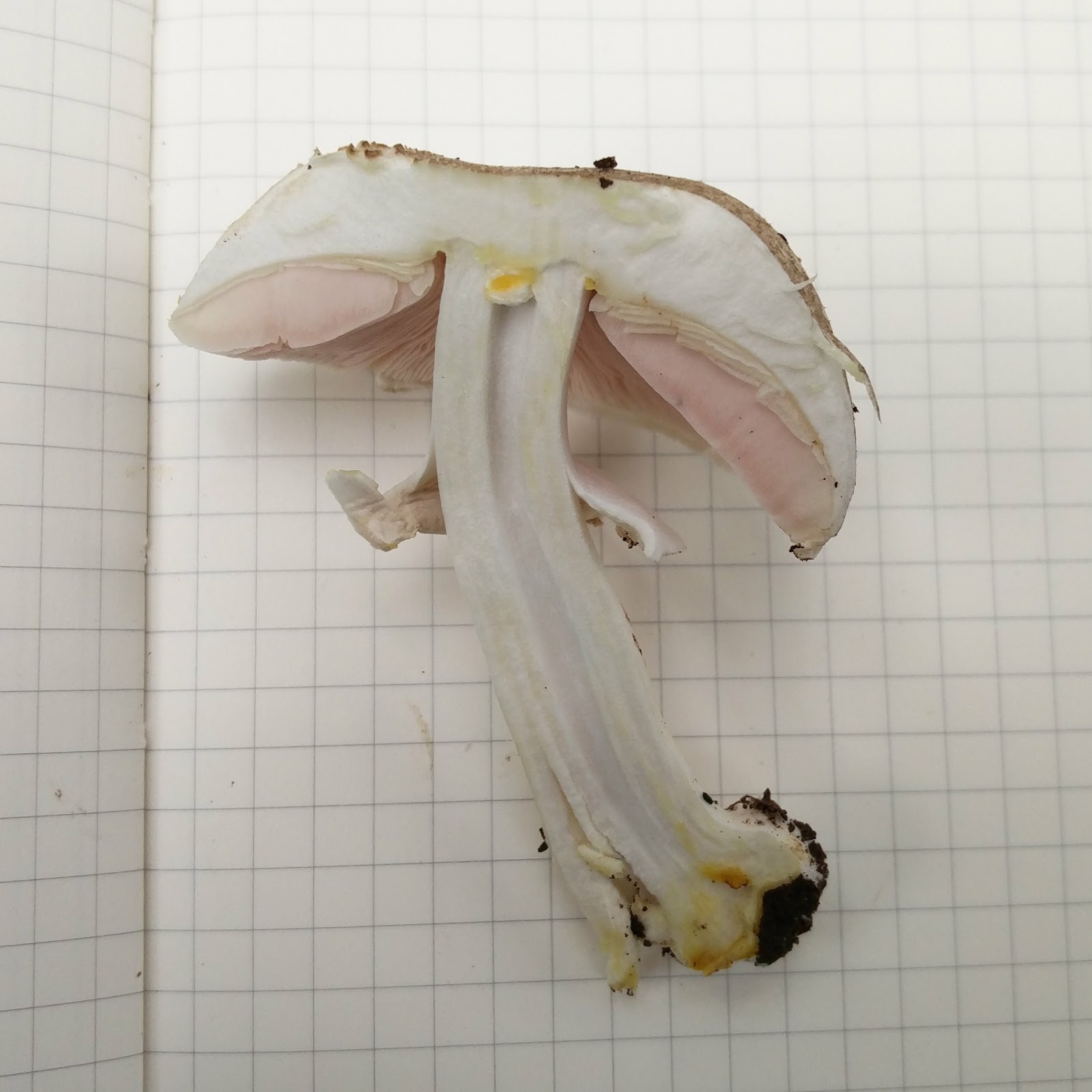
Greyish-white agarics were growing in a few different spots, under Hawthorn. Nick identified these as the Inky Mushroom Agaricus moelleri. The smoky-grey scales on the cap are a distinctive feature of this species.


The flesh turns rapidly yellow when cut, particularly at the base of the stipe, as you can see here.


I think that was about it for the woodland species. We retraced our steps and moved on to the grasslands.

Growing among the lush grass at the top of the hill, we found quite a number of Pestle Puffball Lycoperdon excipuliforme, in various states of decay.


I've not seen this species before, so was pleased to find this one looking really fresh. I'm not sure what the rest of my Sussex Fungus Group comrades are looking at in the background. Probably something really rare.


We came across a few little brown jobs poking up through the grass, including this one.


Nick suggested I take this one home and see if has the impressive star-shaped spores of the Star Pinkgill Entoloma conferendum.

It has produced a rather nice pink spore print.


But the spores are just kind of hexagonal. Like LOTS of Entoloma species.


I'm not sure I've got it in me to key out a little brown Entoloma if it hasn't got exciting star-shaped spores, so let's be happy we've got this one to genus and move on.

It was nice to see this species again, after first encountering it at Worth Park the other week: Pink Domecap Rugosomyces carneus.


We found a few Parrot Waxcap Gliophorus psittacinus as well as Spangle Waxcap Hygrocybe insipida. And the ascomycete fans were pleased to find this:


No, it's not a bit of mouldy old satsuma peel. It's a cup fungus of some kind. Nick Aplin took a specimen away to confirm its identification (he thought possibly Sowerbyella radiculata).

Fool's Funnel Clitocybe rivulosa was another new species for me.


I haven't really got my head around the Clitocybe mushrooms yet. I find there are a lot that tend to look rather the same; so I shall have to try and at least fix this one in my mind.

Seaford Head is famous for its population of Moon Carrot Seseli libanotis: not a fungus, but a very rare plant – soon to feature as the cover star of the 'The Flora of Sussex' (currently available for pre-order, get your copy here!).


So, here we are looking for microfungi on the dead stems of Moon Carrot, with Seven Sisters behind us.

We didn't find any on this occasion, but – in the words of Nick Aplin "where there's a niche, there's a fungus" and a quick Google search reveals there is indeed a Moon Carrot Rust Puccinia libanotidis, previously regarded as extinct in Britain until it was rediscovered in 2009. Apparently it typically appears from May to August, so we shall have to return in late Spring / Summer to find that one.

UPDATE 27/10/2017: It was Dr. A. Martyn Ainsworth who recorded the Moon Carrot Rust Puccinia libanotidis at Seaford Head. He wrote an article about it in the journal Field Mycology, here, and there are photographs of the Moon Carrot, here, showing the scattered cinnamon brown fruit bodies ('uredinia') of Puccinia libanotidis (although I'm afraid you will need to subscribe to Field Mycology to access the links). So now I know what to look for next time I'm at Seaford Head!

For the record
Date: 14 October 2017
Location: Seaford Head
Grid reference: TV5097

All records to be submitted by Nick Aplin on behalf of Sussex Fungus Group.