Saturday, 8 July 2017

Summer Fungi at Burton & Chingford Ponds

It hardly seemed like fungus-hunting weather at Burton and Chingford Ponds yesterday.


But I'd had a tip-off. Michael had led a Sussex Wildlife Trust members' walk around Burton Pond the day before and returned with this tantalising photograph of an oyster mushroom.


What a difference a day makes!


By the time I got there, the mushrooms were all dried out and stained yellow with age. The fruit bodies were hard and brittle. Snapping one off revealed a writhing mass of black-tipped maggots, chomping away on the dessicated flesh.


The maggots rather put me off taking a sample. And anyway, I thought it might be difficult obtaining some spores from the dried out gills. So I settled for taking a bunch of photographs.

This one shows some of the stems, fused together into a common base. But I don't think they're truly 'branching' in the way you'd expect from the Branching Oyster Pleurotus cornucopiae.


This photograph shows the stem a little better.


As you'd expect from an oyster mushroom, the gills are strongly decurrent (running down the stem); but the gills/ridges don't extend all the way down the stem. Again, I think this feature means it's unlikely to be P. cornucopiae.

But what is it? Having also consulted with Funga Nordica, I think the combination of pale flesh and summer fruiting mean it's likely to be the Pale Oyster P. pulmonarius. This species occurs on both living and dead deciduous wood, including birch (Betula), as it is here.

Continuing on, this standing dead tree was covered in swarms of King Alfred's Cakes Daldinia concentrica.


And I was delighted to come across this large mushroom, growing in parkland -type habitat, under some old oaks.


As you can just-about-make-out in the photograph, it had a large round bulge at the bottom – a volva – which had become partially hollowed-out and was providing a home to a very active family of woodlice.


The cap was this rather attractive olive-green colour.


And while the gills were still covered in the remnants of a partial veil (?) I could see no hint of a ring.

This leaves me in something of a quandary, as the mushroom matches many features of the Deathcap Amanita phalloides, but it doesn't have a 'pendulous ring' around the stem.

I wondered if it could be a Grisette Amanita vaginata. But a key feature of that species is its 'striate' (stripy) margin. And this mushroom doesn't have that.

I found a couple of younger specimens growing nearby, so I looked to see if those showed any signs of a 'pendulous' ring. But they didn't.


The partial veil's falling off in the wrong direction! Towards the cap margin, rather than the stem.

Note also the mottled lower stem – showing the same colouring as the cap. This is also a feature of A. phalloides. And the cap has a sweet and slightly vinegar-y smell to me, which the books say is also a feature of A. phalloides.

I think it probably is the Deathcap A. phalloides.

UPDATE 08/07/2017: I posted these pictures on the British Mycological Society Facebook page and Geoffrey Kibby was kind enough to confirm my identification. Success! 

Then I saw this Common Toad Bufo bufo. Hello!


Thought I'd give it a guest appearance in this fungus blog, given toads' long association with the mushroom kingdom!

One of the nice things about the walk around Burton & Chingford Ponds is the great variety of habitats it takes you past: woodland, heath, bogs and ponds. As you reach the furthest point from the car park at Burton Mill, the route goes through an area of pine plantation. And it was here I spotted a smattering of earthballs.

Earthballs are covered in the new book by Geoffrey Kibby, so I thought, I CAN DO THIS! (Other field guides have always left me a little confused as to how you separate the different species).


The earthballs were growing at the side of the path, under conifers, amongst leaf litter over very sandy soil.


The earthball seemed almost fused into the leaflitter by mycelia; the stem was almost absent. In the young fruit body the spore mass ('gleba') was white and just starting to flush a purplish-black colour. The surface of the fruit body was covered in tan-brown patches, broken up into an irregular pattern.

I think it probably is the common species, Common Earthball Scleroderma citrinum. But Kibby's book makes me think I should check the spore ornamentation to be sure. I don't think I can do this without mature spores, and without staining chemicals to highlight the ornamentation. Oh well, at least I know what to do next time.

In what proved to be a surprisingly fruitful trip for a dry day in July, I found a few little mushrooms growing at the side of the footpath, on sandy soil.


They had crowded gills, which were a pale mousy-brown colour.


The caps were quite conical and rounded at the top (without a discernable 'umbo'). The cap colour was a sort of non-descript beige, overlain with tan speckling (veil remnants?).

I think it might be a Psathyrella species. I'll try and get a spore print and see where that gets me.

I also found another earthball, this time growing in the heathy grassland near the Black Bog. This one had more obvious 'patches' on the surface.


I assume the spores had just recently matured, as the gleba was this glistening blue-black colour.


I'll see if I can get some spores out of this one...

UPDATE 08/07/2017: 

Geoffrey Kibby's book explains that spore ornamentation is a key identification feature in the genus Scleroderma the Earthballs. Spores are typically spiny and can also be covered in a network of ridges, in which case they are described as 'reticulate'. This graphic from Michael Kuo's mushroomexpert.com site shows the different kinds of ornamentation you might see in Scleroderma species.
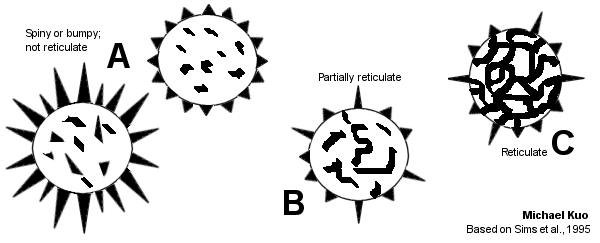
Image reproduced from www.mushroomexpert.com. © Michael Kuo


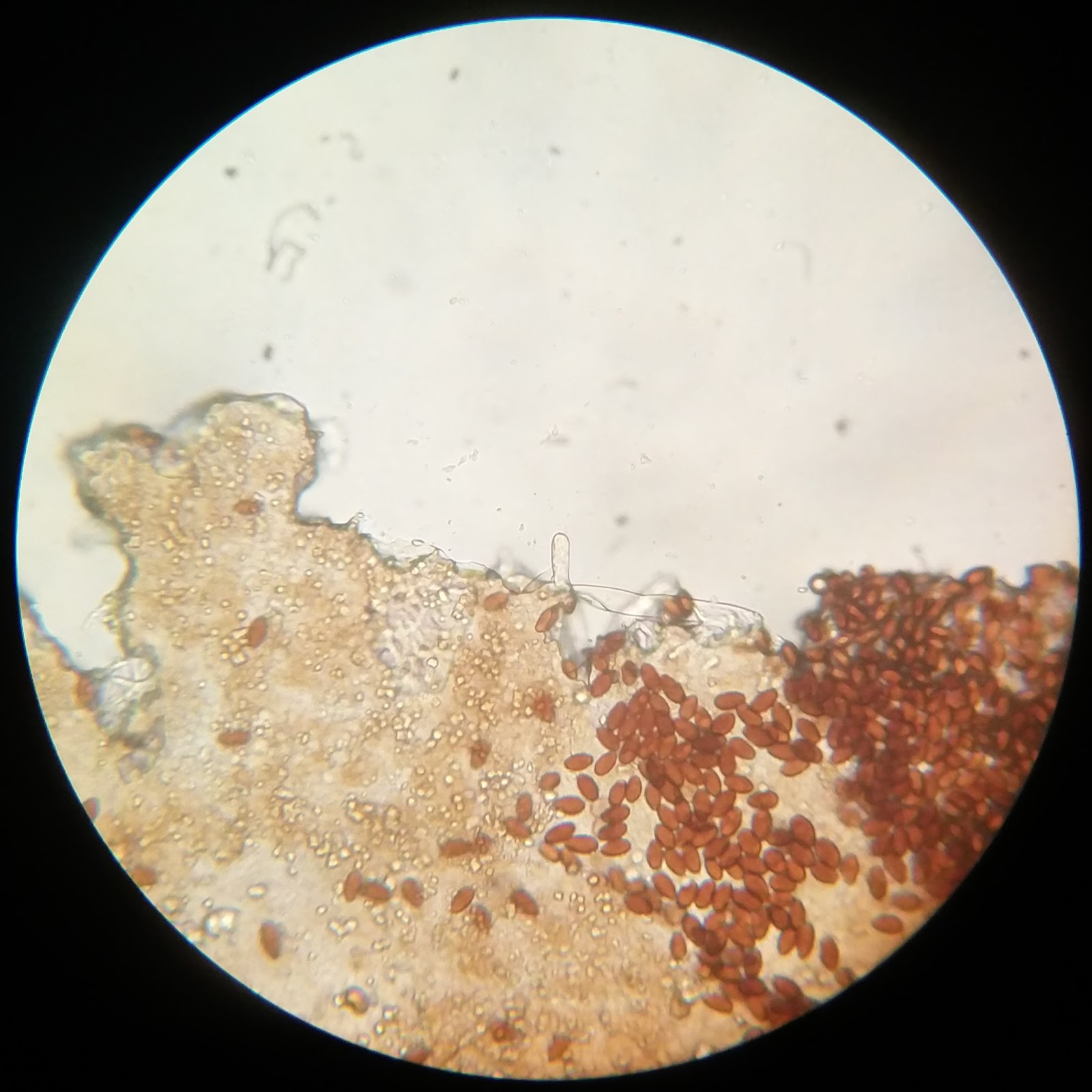
This is the best image I've been able to get of the spores from my collection.


You can see they've got some impressive spikes on them, but I can't get the image clear enough to tell if the spores are reticulate or not. 

So, there we go. I'm stuck again. 

For the record
Date: 8 July 2017
Location: Burton & Chingford Ponds
Grid ref: SU9717

P. pulmonarius, D. concentrica and A. phalloides entered into FRDBI 06/09/2018

Saturday, 24 June 2017

Copping out

I went to visit a new site today: Broadmare Common, just south of Henfield in West Sussex.


I was pleasantly surprised to discover an intepretation board on my arrival, explaining the history of this area of common land. From the 17th century to the early 20th century it was an industrial area for the digging of clay used to make bricks. It's now managed by the Henfield Conservation Volunteers for people and wildlife to enjoy.

The common boasts a reasonably extensive area of wet woodland and many small ponds, so I thought this might be a good spot to find some fungi during this dry month of June.

There's lots of this sort of thing, so I was glad I had my boots on.


I found a few different ascomycetes and bracket fungi growing around the ponds, plus loads of myxomycetes (slime moulds) from the genus Stemonitis, which I'll come back to later. But it was at the edge of this pond that I found my one and only mushroom for the day.


It was a small, pale and delicate mushroom, growing on what I assumed to be a willow twig. It was very near the edge of the pond, where the ground is probably permanently wet.

I wouldn't normally attempt to identify a little thing like this, but in several respects it seemed quite distinctive, so I thought I would have a go.


The cap was topped with a neat little tan umbo (pointy bit). The cap itself was pale, translucent, and pleated forming radial ridges. Underneath, the gills were a darker mousy brown; the colour was visible through the translucent cap cuticle, giving the cap the appearance of being mousy brown to about 2/3 of its radius. The gills appeared to be free: attached to the cap, around the stipe; not abutting the stipe itself. The stipe was the same translucent white as the cap cuticle, and tan coloured right at the foot of the stipe, above the white mycelial strands which anchored the mushroom to its twig.

I started off down completely the wrong track, thinking it was a Bonnet mushroom one of the Mycena or Marasmius species. But the brown gills meant it must be something different. I eventually realised that this mushroom belongs in one of the Inkcap genera. I'd been fooled by that pale margin, without the slightest hint of deliquescing inkiness; but not all Inkcaps deliquesce, of course.

I flicked through the Collins Fungi Guide, looking for species matching mine which would be found on twigs.

Coprinellus subdisseminatus seemed like an excellent match, but I thought I'd best check its microscopic features against the description in Funga Nordica, to be sure.

This is where I've got stuck. The genus Coprinellus seems to comprise a lot of really rather similar mushrooms. And I wasn't sure I'd managed to find any of the things I was looking for down the microscope.

The first thing I noticed, aside from the brown spores, were these spherical things. What the heck were they?


After much poring over the keys in Funga Nordica, I came to the conclusion they might be 'velar spherocysts' – round things which are found on the cap of some Coprinellus species. 

They did seem to occur primarily in the cap (which I should possible refer to as the 'pileipellis'):


According to Funga Nordica, only some species of Coprinellus have 'velar spherocysts'. C. subdisseminatus is one of the species which is "without velar spherocysts". So I guess my mushroom isn't that after all...

The problem that I had then is, in order to ascertain what species of Coprinellus my mushroom actually is, I needed to get a good look at the cystidia (weird structures which can be found on the surface of the mushroom no one knows what they're for).

There are different names for the cystidia, depending where they're found on the surface of the mushroom. In Coprinellus mushrooms, it seems the ones you need to look out for are:
  • cheilocystidia - cystidia on the edges of the gills
  • pleurocystidia – cystidia on the faces of the gills
  • pileocystidia – cystidia on the surface of the cap
  • caulocystidia – cystidia on the stipe
Funga Nordica also talks about 'sclerocystidia' but that word's not in the glossary and I have no idea what it means.

So, I found some stuff.

There was this:


I guess those rolling-pin type shapes could be pileocystidia.

There was also this:


I have no idea what that is, but it's very pointy.

And I thought I could possibly detect some cystidia here:


... and here:


But, in conclusion, finding cystidia on tiny Coprinellus mushrooms is really hard and I still have no idea what species this is.

THE END

For the record
Date: 24/06/2017
Location: Broadmare Common
Grid reference: TQ216150 (site centroid)

Monday, 12 June 2017

Do my eyes deceive me?

Quick mooch around the woods after work today and was pleased to find a mushroom which looked new-to-me.


When I looked closely, there were a few of these mushrooms scattered over a patch a metre or so wide, and a couple growing in a little clump. But most of the others were looking very old and dried up.

The first thing I noticed was the deep depression at the centre of the cap.

It was growing up through leaf-litter and I decided I'd better dig it up for a closer look, revealing this tough, fibrous and twisted stem, rooted in the ground. At the base, white mycelia disappeared into the soil.


Stem and cap are a tan colour, with dusky pink gills.

I was pretty sure these features put me in the realms of the Laccaria The Deceivers. The key to the Laccaria in Funga Nordica is only three pages long. Joy!

One of the features the key asks me to look at is the 'basidia'. This is a new term for me: basidia are spore-bearing structures, as illustrated by this handy image from wikipedia.


This is really hard! Especially when I haven't got any stains yet, which means everything just looks white. But I think the blurry structure in the middle of this photo might just be a 4-spored basidia.


I also checked out the spores, which look pleasingly spiky and spherical, like this:


Am reasonably confident all this takes me to The Deceiver Laccaria laccata.

For the record
Date: 12/06/2017
Location: Horton Wood, Small Dole
Grid reference: TQ208127 (site centroid)

Record entered into FRDBI 06/09/2018

Wednesday, 7 June 2017

Sordid White

I passed these mushrooms on my walk to work. They were growing in a grassy area, under trees, and next to an old stump. There were a few little clumps poking up through the grass, in a patch a couple of metres wide. They weren't far from my office, at Woods Mill, so I decided I'd go back at lunchtime for a closer look.


Preliminary investigations revealed a dusting of brown spores on the caps beneath the uppermost mushroom.


This put paid to my first theory that they might be Fairy Ring Champignon Marasmius oreades – because they evidently don't have a white spore print.

The most striking feature of these mushrooms was their growing habit: sprouting up in a clump and strongly fused together at the bottom. The other thing I noted was their brittle stems which made an audible snapping sound when even slightly bent; and no ring around the stems.


Flicking through the Collins Complete (photographic) Guide that I now try and carry around with me wherever I go, I couldn't immediately see any candidates which matched what I was seeing. But then the photographs in that book are almost all taken looking down upon the cap, which doesn't give you much to go on when trying to match other features such as the gills and stem.

I took a specimen and resolved to investigate further, after work.

Once home, I took my copy of Mushrooms by Roger Phillips off the shelf and flicked through it, looking for something to match what I'd seen. When I got to this page – the Psathyrella – I reckoned I must be pretty close.


Feeling cocky, I then turned to Funga Nordica, to see if I could key out my mushroom. But I got stuck trying to determine if it had pleurocystidia or not, as I wasn't sure what I should be looking for.

I did have some success measuring the spores. I think these are about 8 microns in length.


And – not very easy to see when they're just mounted in water – but I think these are cheilocystidia growing along the gill edge. Their skittle shape, which you may or may not be able to make out in this photo, is described as 'utriform' in mycology-speak.
 

I didn't quite manage to get through the keys to the Psathyrella they include some tests I can't do because I haven't got the right kit (e.g. ammonia). But I think my mushrooms are a good match for Pale Brittlestem Psathyrella candolleana.

I was unsure at first because Funga Nordica describes the cap as "dark reddish brown, becoming ochraceous brown, at maturity fading to ochre with yellow, grey, purple or violet tinges" and I don't think my mushroom is any of those colours! However, it goes on to describe the cap as "hygrophanous, drying sordid white or grey". Well, I guess you could describe the cap as "sordid white". Although that seems an extraordinarily odd description for a colour. The colour of Miss Havisham's dress, perhaps, after all those years shut up in her mansion?

I couldn't see any trace of a veil, but I think these mushrooms were a couple of days old by the time I got to them, and the recent heavy rain could have washed this away. I noticed the fresher caps have a slight sparkle to them, when you get them up close; I don't know if that's indicative of anything. And the margin is faintly striate.

The habitat and time of year also seems right for P. candolleana, as Funga Nordica describes it as occuring "in rich deciduous forests, parks and gardens on or around stumps...; spring to autumn."

So, P. candolleana seems quite likely. But I wouldn't like to say for certain as Psathyrella seems a more complicated genus than the field guides would have you believe.

For the record
Date: 07/06/2017
Location: Hoe Wood
Grid reference: TQ217136

Sunday, 21 May 2017

Off with the Fairies


Found some more mushrooms at Woods Mill today. I think these are Fairy Inkcap Coprinellus disseminatus.

Never seen these before; they look like Glistening Inkcap Coprinellus micaceus but they're much smaller.

For the record
Date: 21/05/2017
Location: Hoe Wood
Grid reference: TQ218136

Saturday, 20 May 2017

Look who's back!

It's been too long since I had some fresh fungus to ID so I took myself off to Woods Mill today with my fungus hunting paraphernalia, determined to find some fruit bodies; hoping the recent rain might have precipitated some action.

Of course I saw all the usual same-old same-old: King Alfred's Cakes Daldinia concentrica, some old Jelly Ear Auricularia auricula-judae, Glue Crust Hymenochaete corrugata and Turkeytail Trametes versicolor. 

But nestled in amongst this old Turkeytail Trametes versicolor, I spotted something that looked a bit different.


Algae has turned the Turkeytail Trametes versicolor a beautiful mossy green colour; the pale fruit bodies are something else Bitter Oysterling Panellus stipticus.

Not super exciting, as I've seen this species before at Woods Mill. But this specimen nicely shows the cracked and 'scurfy' cap surface which is characteristic of this species.


Nearby, I spotted these mushroom-like fruit bodies growing on a well-rotted old branch.


Look! No gills.
These reminded me of the Bay Polypore Picipes (=Polyporus) badius I found last August, but the fruit bodies are much smaller, less than 4 cm across.


The margin appears quite smooth...


So I think this puts us in the realms of the Winter Polypore Polyporus brumalis; although according to the books it's not really the season for it.

Next up, a Trametes species.


This one looks a bit different to the Turkeytail Trametes versicolor that I've got used to seeing everywhere. The brackets are a bit chunkier. Pores are round. And the upper surface feels like chamois leather.

I'm thinking possibly Hairy Bracket Trametes hirsuta, but not 100 % confident.

In Hoe Wood I was very excited to see A MUSHROOM! Growing up through the leaf litter. The stem tapered slightly from a thick base; but I couldn't see any sign of a volva.


It must have just recently sprung up, after the rain, as the gills are still covered by a partial veil.


I didn't want to ruin its reproductive display so I took just a tiny sliver of the cap, to get a look at the gills. They're white, and crowded. And they don't smell of anything in particular.

So, erm, I'm not sure what this is. My first thought was Deathcap Amanita phalloides var. alba. But I can't see any sign of a "large, bag-like white volva". So I'm not convinced it is actually an Amanita. I'll try and get a spore print from my sample and may go back tomorrow for another look.

UPDATE 22/05/2017 After a misunderstanding with a kerb on Saturday evening, I limped back into Hoe Wood on Sunday to get another look at that white mushroom. It had been knocked over by some woodland creature, since I left it on Saturday. So I thought I'd take it home for a closer look. 

After a day in a margarine tub on my desk, the cap has opened to reveal a load of gorgeous chocolate-brown gills. Not white any more! So that's taught me something.

As Ted surmised in the comments below (thanks Ted!) – I can see it's definitely an Agaricus. And it's left a dark brown spore print in my margarine tub.


The key to the Agaricus runs to 12 pages in Funga Nordica. Hmm. We'll have to see how this goes...

*Checks to see if the stem base turns yellow when rubbed* Nope. 
*Checks to see if it smells of bitter almonds* I don't think so. What do bitter almonds smell like?
*Googles "Schäffer reaction"* Damn! If only I had some aniline & nitric acid lying around.
*Checks to see if cap goes yellow when bruised* Hmm... Not really. I'll go to question 11.
*Looks at 'ring'* It's definitely hanging down.
*Checks to see if flesh in stem top is 'reddening', to some degree* Um. Don't think so? I'll go to question 26.
  
Uh oh! I have to look at its spores. *Gets microscope out*

So, the spores look like this:


*Checks to see if the spores have a 'germ pore', or a wall which is 'uniformly thick'* I can't see any sign of a 'germ pore'. That takes me to question 27.
*Looks at cap again* Cap is definitely either 'white, whitish or dirty greyish yellowish'. On to question 29...
*Looks to see if the stem is longer than the cap* – Nope, about the same length as cap diameter. 
*Has a sniff to see if the smell is unpleasant; metallic* – Don't think so. Just smells kind of mushroom-y to me. This takes me to question 30.

Cripes! I've got to measure the spores now. I haven't done this before, but I did calibrate my new measuring eyepiece the other day, so this could work.


Based on my previous calibration, I think one unit on that scale you can see is about 10 microns. That makes the spore I'm measuring about 7 microns.
 
*Checks to see if the spores are, on average, < 8 μm long* – Yes! On to question 31.

This takes me to a description of... wait for it... Field Mushroom Agaricus campestris! Well, if it's that, what's it doing growing in the middle of wood? 

FURTHER UPDATE 23/05/2017 Martin Allison emailed. He's not convinced my mushroom's A. campestris. "The ring looks too big and floppy!" He said. So, there we are. The mushroom went in the bin last night, so it's identity must remain forever a mystery.

Last up, my old friend Chicken of the Woods Laetiporus sulphureus, growing on the same log where we found it last year.


What a beauty!

I grew quite attached to this fungus during its fruiting season last year. I watched it develop from plump, peachy pillows into bright frilly brackets. It seemed quite beautiful to me even as it slipped into senescence; until it finally fell to earth on the day of the referendum result. True story.

Chicken of the Woods Laetiporus sulphureus at Woods Mill, 2016. IMAGE | Clare Blencowe.

For the record
Date: 20/05/2017
Location: Hoe Wood
Grid reference: TQ217136

D. concentrica, P. stipticus, P. brumalis & L. sulphureus entered into FRDBI database 06/09/2018