I don't know much about Fungi. What I do know is, they're mostly pretty hard to identify to species. So this is me, trying.
Sunday, 3 July 2016
Secret Wildlife
This weekend, at a secret location in deepest Sussex, families gathered for the fourth annual Secret Wildlife Festival. I was there, officially in a 'helping out' capacity, but I had a secret mission of my own: To find more slime moulds.
The highlight for me was a trip round Knowlands Wood, a privately-owned woodland of old hornbeam, oak and mixed coppice, with Nick Lear who has been actively managing the site for wildlife since he acquired it more than thirty years ago.
Along one of the wide, sunny rides – ideal for butterflies, if only the sun were shining – we spotted this bulbous beauty.
I think it's Reticularia lycoperdon (synonym Enteridium lycoperdon) – a slime mould. But as the group hurried on, in pursuit of White Admirals, I didn't have much opportunity to study it.
After passing through the butterfly glades, where a few fleeting rays of sunshine brought the promised White Admirals and Silver-washed Fritillaries, we entered an area of dense and damper woodland – mostly hornbeam with a few old oaks.
Scanning the woodland floor for signs of life, I was thrilled to see this: An army of Dead Moll's Fingers Xylaria longipes trooping along the dead wood.
The books say Dead Moll's Fingers Xylaria longipes are found on fallen branches of broad-leaved trees, especially Maples and Sycamore. They don't say anything about Hornbeam but they sure seem to love it here.
It's not hard to see why they're called Dead Moll's Fingers. They give a very good impression of dead fingers clawing their way up from the underworld.
According to my field guides, Dead Moll's Fingers Xylaria longipes are more slender than the perhaps-better-known Dead Man's Fingers Xylaria polymorpha and have a longer stem. The Collins Complete (Photographic) Guide also mentions that the stem of Dead Moll's Fingers Xylaria longipes doesn't snap when bent, unlike X. polymorpha. So I think I'm on reasonably safe ground with my identification.
There must have been thousands through this stretch of woodland. They're really fabulous looking things.
I was trailing far behind the rest of the party, so it wasn't until I got back to camp that I discovered no one else had spotted these denizens of dead wood surging up through the woodland floor and surrounding us.
That wasn't all this stretch of woodland had in store. With a bit of looking, I managed to find two more slime moulds...
There was this tapioca-like thing growing on a fallen oak tree, which I'm struggling to identify:
And another example of Wolf's Milk (a Lycogala species):
The colour seems a deeper, more carmine shade than I've seen previously. Perhaps it's L. epidendrum...?
For the record
Date: 3 July 2016
Location: Knowlands Wood [private site]
Grid reference: TQ4117
Fungus record entered into FRDBI: 13/02/2017
Wednesday, 22 June 2016
A Mouldy Lunch
With all this warm, damp weather we're having, I couldn't resist popping over to Hoe Wood at lunchtime for a quick poke around.
First up, a nice lunchtime treat: Dog's Vomit Fuligo septica
Close by, a lone drop of Wolf's Milk Lycogala sp.
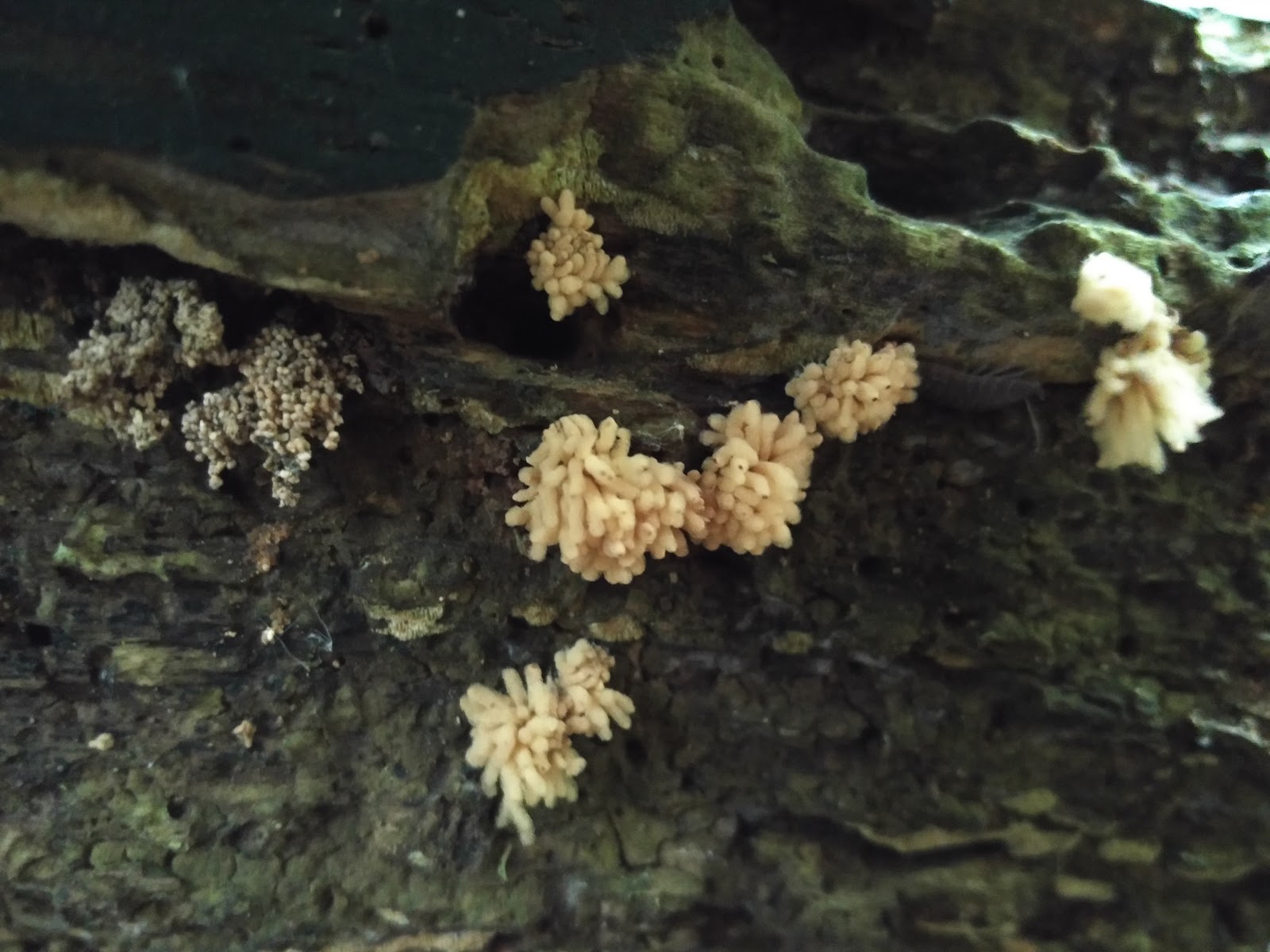
This next one's a new one for me: Mustard-yellow sporangia on a darker stalk.
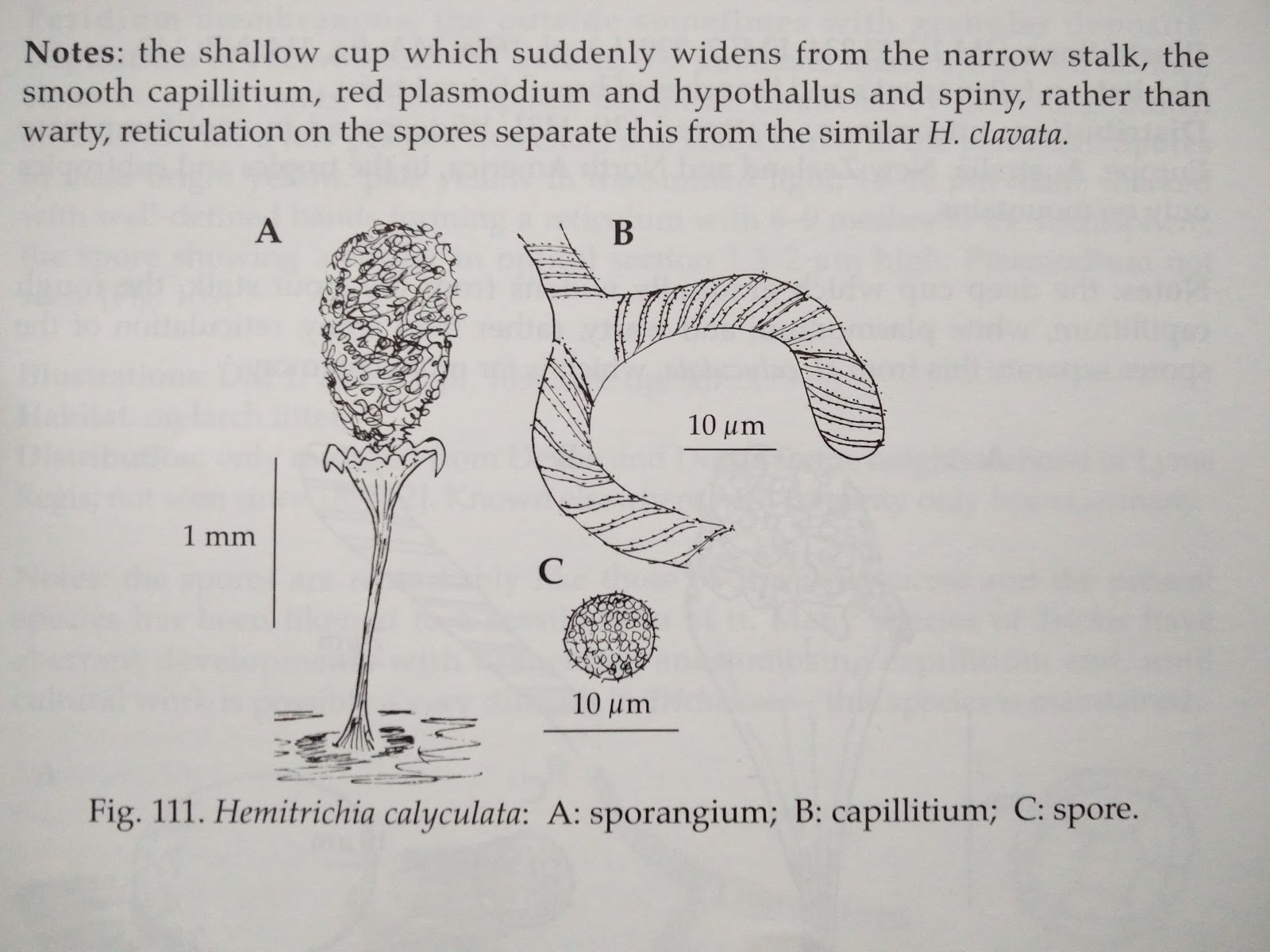
A look down the microscope shows those sporangia are like teeny-tiny afros, held in a conical cup which gradually widens from a dark brown / amber stalk.
After much Googling and perusing of Bruce Ing's Myxomycetes of Britain & Ireland, I think I've got the identification down to one of two species: Hemitrichia clavata or H. calyculata.
![]() |
![]() |
| From The Myxomycetes of Britain and Ireland, An Identification Handbook, by Bruce Ing |
The deepness of the cup is one of the key features that separates these two species. But the cup on the specimen I'm looking at looks like it's somewhere in the middle of the two diagrams.
I tried to get a look at the capillitium (i.e. the threads of that afro) under the microscope, but it's pretty hard when you have ABSOLUTELY NO IDEA WHAT YOU'RE DOING.
I did manage to observe this branching structure, which Ing's species description suggests might be indicative of H. calyculata. But I can't make out any of the other identification features.
I think that probably leaves the species identification too close to call. But I'll take some comfort from the fact that, according to Bruce Ing's book, these two species were not separated until the work of Martin and Alexopoulos in 1969.
Last up, an easier one (I believe), Coral Slime Mould Ceratiomyxa fruticulosa.
It's a pretty little thing.
For the record
Date: 22/06/2016
Location: Hoe Wood, Small Dole [private site]
Grid reference: TQ2113
Saturday, 18 June 2016
Magic Crystal Mould?
In this damp corner of a Sussex woodland, clinging to the dead wood littering the floor, lives an organism.
It looks like this:
And under the microscope you can see it has this irregular, slightly branching form:
The surface appears powdery and almost crystalline, like one of those magic crystal trees you might have got for Christmas when you were a kid. I guess these are spore-bearing structures of some kind.
I smeared that powdery surface across a microscope slide and got a whole load of this:
Elliptical things... Spores?
In conclusion: I have no idea what this is.
(I have spent several hours trying to make it some kind of Fuligo species – a type of slime mould – but they mostly have round spores.)
For the record
Date: 18/06/16
Location: Horton Wood, Small Dole
Grid reference: TQ208127 (site centroid)
Sunday, 12 June 2016
Nice weather for slime moulds
Thought I'd go and see if there was anything going on in the woods today, with the warm wet weather we've been having.
I found another slime mould.
![]() |
| That log in the foreground providing some prime slime mould habitat. |
It was a distinctive mustard-yellow colour and growing in clumps, reminiscent of Sideshow Bob's hair.
After some judicious Google image searching and reference to The Myxomycetes of Britain and Ireland, I'm reasonably confident this is Arcyria obvelata.
The yellow, drooping and loofah-like sporangia (structures which holds the spores) are identifying features of this species, which the book says is very common throughout the British Isles.
And here's one of those sporangia under the microscope. Definitely looks like a loofah!
For the record
Date: 12/06/16
Location: Horton Wood, Small Dole
Grid reference: TQ208127 (site centroid)
Recorded entered into iRecord
Wolf's Milk
Back in Sussex
To Horton Wood in search of a fungi fix. Didn't see any mushrooms or brackets to write home about, but I did see something on this decaying birch log.Blobs!
I had the Collins Complete (photographic) Guide with me so I started flicking through it and soon found a possible match: "Lycogala terrestre – plasmodium stage is a rather spherical pinkish buff ball; found on dead wood, usually in clusters". A slime mould.
The guide has just two pages on slime moulds, mentioning a few of the most frequently encountered species, so I googled "Lycogala terrestre" to see if it might be easily confused with anything else. That's when I discovered the common name of this slime mould is Wolf's Milk. And I read somewhere that the young fruiting bodies are filled with pink plasmodium, i.e. a kind of biological pink slime.
To be honest, that made me really want to poke one. So, here I am, poking it:
(I'm not the first person to upload a video of myself milking a slime mould. There's also this clip with noticeably higher production values.)
Back at home I looked up L. terrestre in my other books. The Collins (illustrated) Fungi Guide doesn't cover slime moulds, which is fair enough as slime moulds are not fungi and belong in a different kingdom entirely. Michael Jordan's Encyclopedia of Fungi does include L. terrestre, in a short section on myxomycetes, and notes it is often mistaken for L. epidendrum. But it didn't leave me too much the wiser regarding how to confidently separate the two species.
At this point I concluded I should really get my copy of The Myxomycetes of Britain and Ireland by Bruce Ing off the shelf.
This incredibly informative tome includes keys to all the species of Britain and Ireland. But I don't use it much as it's written in very technical language which I find difficult to follow.
Again, I managed to narrow the identification down to one of these two species:
- L. epidendrum – "the combination of red plasmodium, dark grey aethalia and grey spore mass separate this species in the field."
- L. terrestre – "the combination of pink plasmodium, pale aethalia and pink spore mass separate this species in the field."
COLOUR OF THE PLASMODIUM – well, I think it's pretty clear from the poking footage that the plasmodium is a salmon-pink colour. Indicative of L. terrestre.
COLOUR OF THE AETHALIA (i.e. colour of the blob) – looks like they start off pink, in the plasmodium stage, and then turn grey. Indicative of L. epidendrum?
COLOUR OF THE SPORE MASS – I guess this means the colour inside the mature, grey, blobs. I had a look and they're grey all the way through (with a texture like a fine Belgian truffle). Indicative of L. epidendrum.
Well, this is confusing. It can't be both, can it?
Turns out I'm not the only one who's confused. I also found this thread where a bunch of myxomycologists are debating whether L. terrestre and L. epidendrum are really two separate species, or illustrative of natural variation within a single species.
This is where taxonomy gets fun, or frustrating, I suppose – depending on your point of view.
For the record
Date: 11/06/16
Location: Horton Wood, Small Dole
Grid reference: TQ208127 (site centroid)
Saturday, 11 June 2016
Belts and Brackets
Fungus observations from LAPLAND
From Sweden we headed for Finnish Lapland and spent a night in Lemmenjoki national park. There's an old forester's cabin by the river – Härkäkoski – which you can rent for €60 a night. This is the view from the sauna:
![]() |
| Looking up the Lemmenjoki River from Härkäkoski, Finland. |
| Bracket fungus. Lemmenjoki national park, Finland. |
I think it might be a Red-belted Bracket Fomitopsis pinicola – seldom recorded in Britain (although one was found recently in Sussex). The Collins Complete (photographic) Guide says it's a common species in Scandinavia.
Apparently I should have held a match to it – the Red-belted Bracket Fomitopsis pinicola has a resinous covering which melts in heat. Shame I didn't know this at the time, as for once I actually had matches with me. Another thing to add to the list of fungus-hunting paraphernalia!
Eye of the Taiga
Fungus observations from LAPLAND
| Muddus national park, Sweden. Credit: laponia.nu |
As I sat, pondering whether I actually like the Daim & salt liquorice chocolate I'd bought by mistake (Answer: "Surprisingly, yes."), my eyes fell upon a most inconspicuous fungus sitting right beside me.
It had the look of a bracket or crust fungus, with a thin and slightly wavy margin, leathery texture and concentric patterning in shades of beige and brown. But the round cap was growing up through the leaf litter on a stem, like a mushroom.
A glance at the underside confirmed its identity as some kind of polypore. (The photograph doesn't show it terrifically well, but you can just about make out the pores which cover the underside:)
I had to wait until I got home to find a likely identity for this little curiosity. It matches well with descriptions of Tiger's Eye Coltricia perennis which the Collins Complete (photographic) Guide describes as an "unusual mushroom-shaped polypore comprising a thin-fleshed cap and short stem". And the Collins (illustrated) Fungi Guide says it's found "especially in sandy acidic habitats and with pine". Sounds about right! Although there are other Coltricia species which occur in Scandinavia, which aren't in my British field guides...
Subscribe to:
Posts (Atom)