I don't know much about Fungi. What I do know is, they're mostly pretty hard to identify to species. So this is me, trying.
Saturday, 18 June 2016
Magic Crystal Mould?
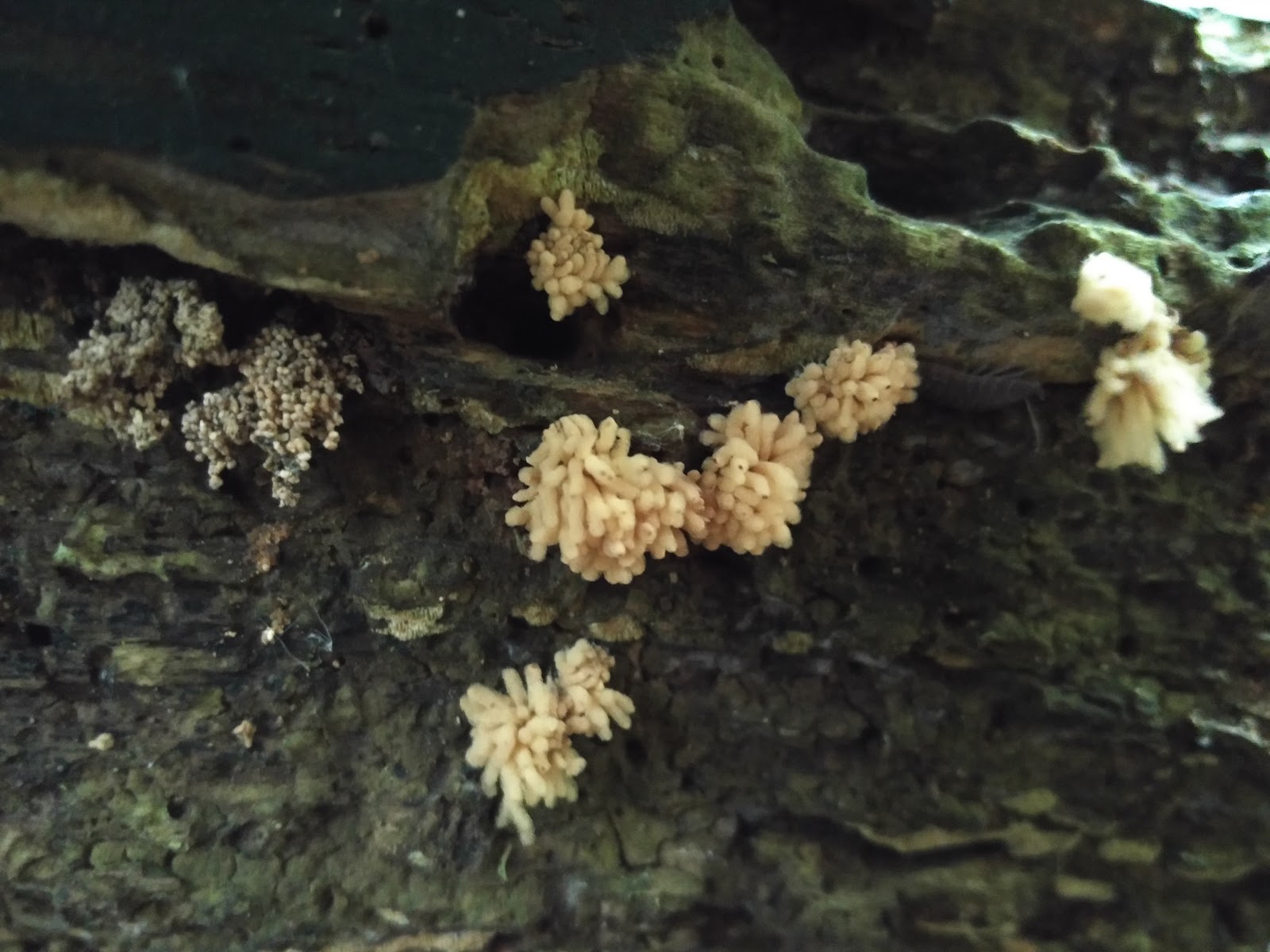
In this damp corner of a Sussex woodland, clinging to the dead wood littering the floor, lives an organism.
It looks like this:
And under the microscope you can see it has this irregular, slightly branching form:
The surface appears powdery and almost crystalline, like one of those magic crystal trees you might have got for Christmas when you were a kid. I guess these are spore-bearing structures of some kind.
I smeared that powdery surface across a microscope slide and got a whole load of this:
Elliptical things... Spores?
In conclusion: I have no idea what this is.
(I have spent several hours trying to make it some kind of Fuligo species – a type of slime mould – but they mostly have round spores.)
For the record
Date: 18/06/16
Location: Horton Wood, Small Dole
Grid reference: TQ208127 (site centroid)
Sunday, 12 June 2016
Nice weather for slime moulds
Thought I'd go and see if there was anything going on in the woods today, with the warm wet weather we've been having.
I found another slime mould.
![]() |
| That log in the foreground providing some prime slime mould habitat. |
It was a distinctive mustard-yellow colour and growing in clumps, reminiscent of Sideshow Bob's hair.
After some judicious Google image searching and reference to The Myxomycetes of Britain and Ireland, I'm reasonably confident this is Arcyria obvelata.
The yellow, drooping and loofah-like sporangia (structures which holds the spores) are identifying features of this species, which the book says is very common throughout the British Isles.
And here's one of those sporangia under the microscope. Definitely looks like a loofah!
For the record
Date: 12/06/16
Location: Horton Wood, Small Dole
Grid reference: TQ208127 (site centroid)
Recorded entered into iRecord
Wolf's Milk
Back in Sussex
To Horton Wood in search of a fungi fix. Didn't see any mushrooms or brackets to write home about, but I did see something on this decaying birch log.Blobs!
I had the Collins Complete (photographic) Guide with me so I started flicking through it and soon found a possible match: "Lycogala terrestre – plasmodium stage is a rather spherical pinkish buff ball; found on dead wood, usually in clusters". A slime mould.
The guide has just two pages on slime moulds, mentioning a few of the most frequently encountered species, so I googled "Lycogala terrestre" to see if it might be easily confused with anything else. That's when I discovered the common name of this slime mould is Wolf's Milk. And I read somewhere that the young fruiting bodies are filled with pink plasmodium, i.e. a kind of biological pink slime.
To be honest, that made me really want to poke one. So, here I am, poking it:
(I'm not the first person to upload a video of myself milking a slime mould. There's also this clip with noticeably higher production values.)
Back at home I looked up L. terrestre in my other books. The Collins (illustrated) Fungi Guide doesn't cover slime moulds, which is fair enough as slime moulds are not fungi and belong in a different kingdom entirely. Michael Jordan's Encyclopedia of Fungi does include L. terrestre, in a short section on myxomycetes, and notes it is often mistaken for L. epidendrum. But it didn't leave me too much the wiser regarding how to confidently separate the two species.
At this point I concluded I should really get my copy of The Myxomycetes of Britain and Ireland by Bruce Ing off the shelf.
This incredibly informative tome includes keys to all the species of Britain and Ireland. But I don't use it much as it's written in very technical language which I find difficult to follow.
Again, I managed to narrow the identification down to one of these two species:
- L. epidendrum – "the combination of red plasmodium, dark grey aethalia and grey spore mass separate this species in the field."
- L. terrestre – "the combination of pink plasmodium, pale aethalia and pink spore mass separate this species in the field."
COLOUR OF THE PLASMODIUM – well, I think it's pretty clear from the poking footage that the plasmodium is a salmon-pink colour. Indicative of L. terrestre.
COLOUR OF THE AETHALIA (i.e. colour of the blob) – looks like they start off pink, in the plasmodium stage, and then turn grey. Indicative of L. epidendrum?
COLOUR OF THE SPORE MASS – I guess this means the colour inside the mature, grey, blobs. I had a look and they're grey all the way through (with a texture like a fine Belgian truffle). Indicative of L. epidendrum.
Well, this is confusing. It can't be both, can it?
Turns out I'm not the only one who's confused. I also found this thread where a bunch of myxomycologists are debating whether L. terrestre and L. epidendrum are really two separate species, or illustrative of natural variation within a single species.
This is where taxonomy gets fun, or frustrating, I suppose – depending on your point of view.
For the record
Date: 11/06/16
Location: Horton Wood, Small Dole
Grid reference: TQ208127 (site centroid)
Saturday, 11 June 2016
Belts and Brackets
Fungus observations from LAPLAND
From Sweden we headed for Finnish Lapland and spent a night in Lemmenjoki national park. There's an old forester's cabin by the river – Härkäkoski – which you can rent for €60 a night. This is the view from the sauna:
![]() |
| Looking up the Lemmenjoki River from Härkäkoski, Finland. |
| Bracket fungus. Lemmenjoki national park, Finland. |
I think it might be a Red-belted Bracket Fomitopsis pinicola – seldom recorded in Britain (although one was found recently in Sussex). The Collins Complete (photographic) Guide says it's a common species in Scandinavia.
Apparently I should have held a match to it – the Red-belted Bracket Fomitopsis pinicola has a resinous covering which melts in heat. Shame I didn't know this at the time, as for once I actually had matches with me. Another thing to add to the list of fungus-hunting paraphernalia!
Eye of the Taiga
Fungus observations from LAPLAND
| Muddus national park, Sweden. Credit: laponia.nu |
As I sat, pondering whether I actually like the Daim & salt liquorice chocolate I'd bought by mistake (Answer: "Surprisingly, yes."), my eyes fell upon a most inconspicuous fungus sitting right beside me.
It had the look of a bracket or crust fungus, with a thin and slightly wavy margin, leathery texture and concentric patterning in shades of beige and brown. But the round cap was growing up through the leaf litter on a stem, like a mushroom.
A glance at the underside confirmed its identity as some kind of polypore. (The photograph doesn't show it terrifically well, but you can just about make out the pores which cover the underside:)
I had to wait until I got home to find a likely identity for this little curiosity. It matches well with descriptions of Tiger's Eye Coltricia perennis which the Collins Complete (photographic) Guide describes as an "unusual mushroom-shaped polypore comprising a thin-fleshed cap and short stem". And the Collins (illustrated) Fungi Guide says it's found "especially in sandy acidic habitats and with pine". Sounds about right! Although there are other Coltricia species which occur in Scandinavia, which aren't in my British field guides...
Friday, 10 June 2016
False Friends
Fungus observations from LAPLAND
My fungus misidentification skills have been abroad! To Lapland – the land of the Sámi – and the vast, wild expanse of the taiga: the boreal forest that stretches across Norway, Sweden and Finland to Russia, and beyond.
First stop was Muddus national park in Sweden, a huge area of old growth forest, lakes and marshes which has been protected from the effects of commercial forestry – first by the glacial landforms which made the area upstream of Muddus's spectacular waterfalls and canyons unsuitable for logging, and later by the work of conservationists who secured national park status for the area in 1942.
| Muddus national park, Sweden. A place so magical the waterfalls look like wizards. |
Arriving in Muddus at the end of May, after the snow and before the mosquitos, we were greeted by temperatures over 25 degrees. Being situated in the arctic circle, around 66 ° North, the sun never really sets at this time of year – so the hot days were followed by balmy evenings which seemed to go on forever.
| Me in Muddus around midnight. |
Many habitats are marvellous in Spring, but I have never before experienced one quite so enchanting. Happily, the park is crossed by well-maintained paths and boardwalks, so there was no cause to worry about any Babes in the Wood -type scenarios.
![]() |
| The babes in the wood who, with hand in hand, went wandering up and down. (SPOILER ALERT: They died). Credit: https://commons.wikimedia.org/w/index.php?curid=1267776 |
My first fungal encounter was with this toadstool, growing by the path. Observing its distinctive wrinkly cap and paler stem, I announced confidently:
"This is a Morel! They're a delicacy in France."
![]() |
| Toadstool in Muddus national park, Sweden |
As the days of hiking through the taiga wore on, I noticed that these toadstools occurred regularly along the sandy, drier sections of the path. They began to seem familiar. I wondered what they would taste like fried in butter.
Fortunately I know better than to trust my mycological knowledge. As soon as we were back in the land of people and mobile phone reception, I turned to the internet for information which might confirm my identification...
These were not Morels! They were False Morels (a Gyromitra species) – DEADLY POISONOUS!!!
I hesitate to put a species name to them as there are probably more Gyromitra species in Scandinavia than are known to me, with my British field guides. But the habitat and 'jizz' match closely with descriptions of False Morel Gyromitra esculenta, said to be "very poisonous".
Imagine then my confusion upon seeing this now familiar fungus lining the shelves in Kiruna supermarket, on tins labelled "Murklor". A quick rummage around in Wikipedia (assisted by the awesome power of Google Translate) suggests that "Murklor" is a collective term for Morels and Morel-like species. However, the list of 'ingredienser' has Gyromitra esculenta – my poisonous friend – as the chief ingredient.
Further trawling through Wikipedia has revealed that, although potentially fatal if eaten raw, Gyromitra esculenta is a popular delicacy; in Scandinavia, not France as I had originally proclaimed. But they must be prepared carefully to reduce their toxicity and, even then, food safety experts seem divided over whether they are actually safe to eat.
I'll stick to just enjoying how they look.
| Another one. In Lemmenjoki national park, Finland |
Monday, 16 May 2016
May the fungus be with you
I'll admit it, I thought fungus was over for the summer.
I should have known better: FUNGUS IS NEVER OVER! It's just waiting for a good day to get fruity.
That's what I've learned this month, after stumbling across these beautiful fruiting bodies basking in the sunny Sussex countryside.
Big, brown and round
Burgeoning from a fallen Ash bough, we spotted this fresh polypore next to a footpath just outside the village of Sutton (near Bignor) while on a butterfly walk with Sussex Butterfly Conservation. We'd done a recce of the route the week before and not seen them, so I reckon these must have sprung up during the first week of May.
Thanks to Cat Åkesson for offering me her hand, for scale – you can see that the biggest of these fruiting bodies were almost the size of dinner plates.
Just about visible in the photograph below, the round brackets are growing from a robust stem (strictly speaking, a 'stipe') and the creamy white underside is a mass of slighty irregular pores.
After consulting with my growing collection of field guides, I am inclined to call this Dryad's Saddle Polyporus squamosus – a common and widespread species which fruits in Spring or Summer. The Collins (illustrated) Fungi Guide describes it as "a large and unmistakably beautiful fungus." So here's hoping I'm not mistaken.
Date: 8 May 2016
Location: Sutton, West Sussex
Grid reference: SU981156
Peaches and cream
Wow! What a find! On a lunchtime stroll around Woods Mill, Roger French caught sight of this voluptuous beauty growing on the end of a big old log (not sure what species – something deciduous).
The colours are just sensational – vibrant shades of peach and apricot. And the surface is delightfully smooth.
A couple of people in our group (not me) recognised it immediately as Chicken of the Woods Laetiporus sulphureus. It's another common and widespread species which fruits in Spring to Autumn.
Personally I think it deserves a prettier name. Like 'Apricot Dream', or something.
Date: 16 May 2016
Location: Woods Mill, Small Dole
Grid reference: TQ217137
Subscribe to:
Posts (Atom)